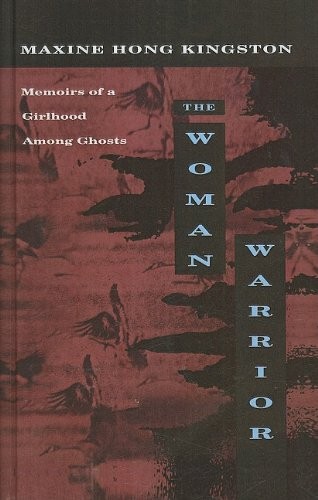
Talk to The Woman Warrior: Memoirs of a Girlhood Among Ghosts like its author wrote you back.
Get the ideas that fit your life — not generic summaries.
- Chat with the book
- Audiobook-style main ideas
- Adapts to your life and goals
- Helps you take action
What it argues
The Woman Warrior is not a conventional memoir. Published in 1976, Maxine Hong Kingston's debut book blends autobiography, Chinese folklore, and myth in a form that deliberately resists separation. The five sections move between Kingston's own childhood in Stockton, California — the daughter of Chinese immigrants running a laundry — and stories she was told, or half-told, or invented from fragments: a legendary female warrior, an aunt whose pregnancy outside marriage was a family secret, her mother's years in China as a midwife and student.
The central preoccupation is the difficulty of knowing where you come from when the stories you're given are incomplete, contradictory, or designed to keep you silent. Kingston's mother tells her "no name woman" — the story of the aunt who drowned herself in the family well — with the explicit instruction that it is never to be spoken of. Kingston speaks of it. The act of writing the book is itself a form of transgression and inheritance: claiming the right to narrate what was meant to remain hidden.
What it gets right
- 1.
Memoir can legitimately incorporate myth and imagination without becoming fiction. Kingston's form argues that the stories we inherit and reinterpret are as much a part of our history as documented fact.
- 2.
Silence is not neutral. In Kingston's account, the silences imposed on Chinese-American women — the stories left untold, the instructions not to speak — are active forms of control.
- 3.
Immigration creates a doubled consciousness that is not resolved by assimilation. Kingston is neither fully American nor fully Chinese, and the book neither mourns nor celebrates that condition — it inhabits it.
What it covers
Who wrote it
Maxine Hong Kingston was born in Stockton, California in 1940, the daughter of Chinese immigrants. She studied at UC Berkeley and went on to teach at UC Berkeley, where she eventually became a professor emerita. The Woman Warrior, her debut book, won the National Book Critics Circle Award for nonfiction in 1976. Her subsequent books include China Men and Tripmaster Monkey. She is widely credited with opening American literature to Chinese-American voices and with establishing the literary form sometimes called "talk-story" — the blending of autobiography and folklore.
