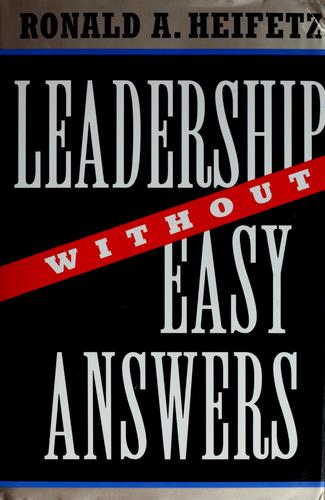
Talk to Leadership Without Easy Answers like its author wrote you back.
Get the ideas that fit your life — not generic summaries.
- Chat with the book
- Audiobook-style main ideas
- Adapts to your life and goals
- Helps you take action
What it argues
Leadership Without Easy Answers is Ronald Heifetz's foundational work on adaptive leadership, developed from his research and teaching at Harvard's Kennedy School. Published in 1994, it introduced the distinction between technical problems — which have known solutions that experts can implement — and adaptive challenges — which require the people experiencing the problem to change their values, attitudes, or behavior. This distinction has since become one of the most cited frameworks in organizational leadership literature.
Heifetz draws on a wide range of case studies, from Lyndon Johnson's handling of civil rights legislation to Gandhi's leadership of Indian independence to the challenges facing physicians delivering difficult diagnoses. The breadth is deliberate: he is trying to show that the technical-adaptive distinction applies across contexts, not just in business management. His argument is that leaders who mistake adaptive challenges for technical problems consistently make things worse, deploying expertise and authority in situations that require people to do their own work of change.
What it gets right
- 1.
The most important distinction in leadership practice is between technical problems, which have known solutions, and adaptive challenges, which require people to change their own values and behaviors.
- 2.
Authority is not the same as leadership. People in positions of authority are expected to provide answers, which makes it structurally difficult for them to lead adaptive work that has no clear answer.
- 3.
Leadership is the activity of mobilizing people to face their adaptive challenges — not solving the problems for them, but creating conditions in which they can do that work themselves.
What it covers
Who wrote it
Ronald A. Heifetz is a physician, cellist, and social scientist who founded the Center for Public Leadership at the Harvard Kennedy School, where he has been on the faculty since the 1980s. Leadership Without Easy Answers grew from his doctoral dissertation and introduced the adaptive leadership framework that became the basis for subsequent books with Marty Linsky and Alexander Grashow, as well as the Cambridge Leadership Associates training organization. His work spans politics, healthcare, business, and community development, and is widely taught in public policy and management programs.
