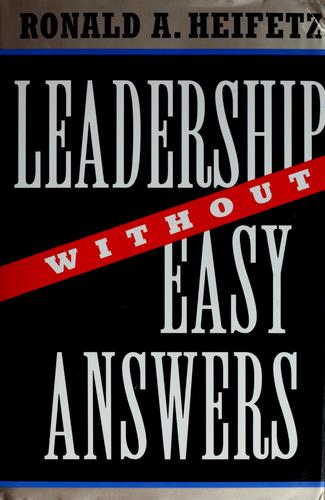
Talk to Leadership Without Easy Answers like its author wrote you back.
Get the ideas that fit your life — not generic summaries.
- Chat with the book
- Audiobook-style main ideas
- Adapts to your life and goals
- Helps you take action
Leadership Without Easy Answers, in detail
Leadership Without Easy Answers is Ronald Heifetz's foundational work on adaptive leadership, developed from his research and teaching at Harvard's Kennedy School. Published in 1994, it introduced the distinction between technical problems — which have known solutions that experts can implement — and adaptive challenges — which require the people experiencing the problem to change their values, attitudes, or behavior. This distinction has since become one of the most cited frameworks in organizational leadership literature.
Heifetz draws on a wide range of case studies, from Lyndon Johnson's handling of civil rights legislation to Gandhi's leadership of Indian independence to the challenges facing physicians delivering difficult diagnoses. The breadth is deliberate: he is trying to show that the technical-adaptive distinction applies across contexts, not just in business management. His argument is that leaders who mistake adaptive challenges for technical problems consistently make things worse, deploying expertise and authority in situations that require people to do their own work of change.
The book's theory of leadership is explicitly non-heroic. Heifetz rejects the idea that leaders have answers and provide them. Instead, he describes leadership as the activity of mobilizing a group to face its adaptive challenges — keeping the collective distress in a productive range, protecting voices that challenge the dominant narrative, and preventing the group from scapegoating or avoiding the real work. Authority is a resource for leadership but also a constraint: those with formal authority are expected to provide solutions, which makes it harder to lead adaptively.
The writing is academic and dense in places — this is Heifetz's dissertation, substantially revised — and the book rewards re-reading more than linear consumption. Readers who want a more accessible treatment should start with Leadership on the Line, written with Linsky. But for those willing to engage with the theoretical foundations, this remains the most rigorous articulation of what leadership actually requires when the problems don't have clear answers.
The big ideas
- 1.
The most important distinction in leadership practice is between technical problems, which have known solutions, and adaptive challenges, which require people to change their own values and behaviors.
- 2.
Authority is not the same as leadership. People in positions of authority are expected to provide answers, which makes it structurally difficult for them to lead adaptive work that has no clear answer.
- 3.
Leadership is the activity of mobilizing people to face their adaptive challenges — not solving the problems for them, but creating conditions in which they can do that work themselves.
