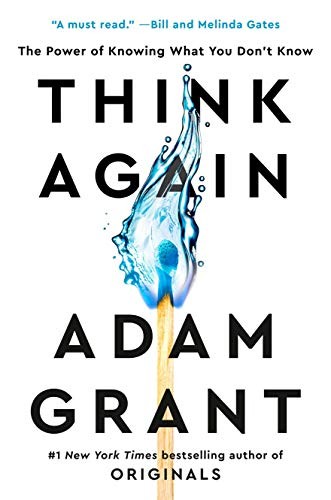
Talk to Think Again: The Power of Knowing What You Don't Know like its author wrote you back.
Get the ideas that fit your life — not generic summaries.
- Chat with the book
- Audiobook-style main ideas
- Adapts to your life and goals
- Helps you take action
What it argues
Think Again is Adam Grant's argument that the most valuable skill in a fast-changing world isn't learning faster — it's unlearning and rethinking more readily. Grant, an organizational psychologist at Wharton, draws on research across psychology, political science, and organizational behavior to make the case that people habitually default to three unproductive modes when their beliefs are challenged: the preacher (defending their views), the prosecutor (attacking others'), and the politician (seeking approval). The scientist mindset — treating beliefs as hypotheses and updating when the evidence changes — is what Grant urges as the alternative.
The book is organized in three parts. The first examines individual rethinking: why experts sometimes know less than novices because expertise produces overconfidence, why good debaters fight less about facts and more about questions, and why Blackboard-style learning (showing students the wrong answers before the right ones) works better than most people expect. The second part examines interpersonal rethinking: how to argue with someone and actually change their mind, why motivational interviewing works, and why aggressive advocacy often backfires. The third part looks at collective rethinking in organizations and society.
What it gets right
- 1.
People default to three unproductive modes when challenged: preacher (defending beliefs), prosecutor (attacking others'), and politician (seeking approval). The scientist — who tests ideas and updates on evidence — is the better model.
- 2.
Experts are often less accurate than novices in fast-changing fields because expertise produces overconfidence and resistance to revising mental models.
- 3.
In debates, asking questions is more persuasive than asserting facts. It forces the other person to work through the logic themselves rather than defending against your claims.
What it covers
Who wrote it
Adam Grant is an organizational psychologist and professor at the Wharton School at the University of Pennsylvania, where he has been the top-rated professor for seven consecutive years. He is the author of several bestselling books including Give and Take, Originals, and Option B, written with Sheryl Sandberg. Grant hosts the TED podcast WorkLife and writes regularly for the New York Times. His research focuses on motivation, creativity, and prosocial behavior in the workplace. Think Again was published in 2021 and became an instant bestseller.
