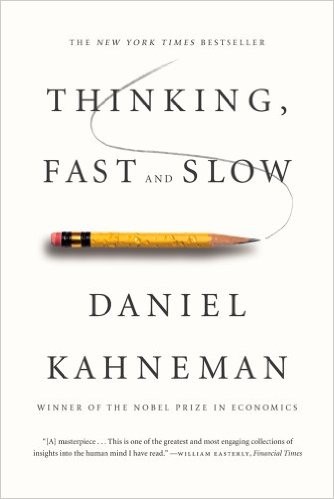
Talk to Thinking, Fast and Slow like its author wrote you back.
Get the ideas that fit your life — not generic summaries.
- Chat with the book
- Audiobook-style main ideas
- Adapts to your life and goals
- Helps you take action
What it argues
Thinking, Fast and Slow is Daniel Kahneman's account of the two cognitive systems that govern human thought. System 1 operates automatically and quickly — it recognizes faces, reads emotions, and jumps to conclusions with minimal effort. System 2 is slower, deliberate, and effortful — it handles complex arithmetic, careful reasoning, and situations where System 1's shortcuts are likely to mislead. Kahneman's central argument is that we are far more System 1 creatures than we believe ourselves to be, and that this mismatch between self-image and reality explains much of the predictable irrationality in human judgment.
The book tours a remarkable catalog of cognitive biases. Anchoring makes us over-rely on the first number we encounter. Availability makes us overestimate the probability of vivid, easily recalled events. The planning fallacy leads individuals and organizations to chronically underestimate time and cost. Overconfidence is perhaps the most damaging of all: Kahneman draws on decades of research to show that experts in many fields are far less accurate than they believe, and that markets, forecasters, and individuals routinely confuse noise for signal. The distinction between what Kahneman calls the experiencing self and the remembering self — the observation that we don't actually evaluate our lives as they are lived but as they are later recalled and summarized — is among the book's most unsettling findings.
What it gets right
- 1.
Two systems govern thought: System 1 is fast, automatic, and associative; System 2 is slow, deliberate, and effortful. Most of our decisions are System 1 in disguise.
- 2.
Cognitive biases are not random errors — they are systematic and predictable. Knowing about them reduces but does not eliminate their influence.
- 3.
Anchoring is powerful and ubiquitous. The first number you hear in any negotiation or estimate sets a reference point that skews every subsequent judgment.
What it covers
Who wrote it
Daniel Kahneman is an Israeli-American psychologist and Nobel laureate who spent most of his career at Princeton University. His decades-long collaboration with Amos Tversky produced prospect theory and a body of research on heuristics and cognitive bias that reshaped economics, public policy, and medicine. He was awarded the Nobel Prize in Economics in 2002, despite being a psychologist — an unusual distinction that reflects how far his work crossed disciplinary lines. His other books include Noise: A Flaw in Human Judgment, co-authored with Olivier Sibony and Cass Sunstein. Kahneman died in March 2024.
