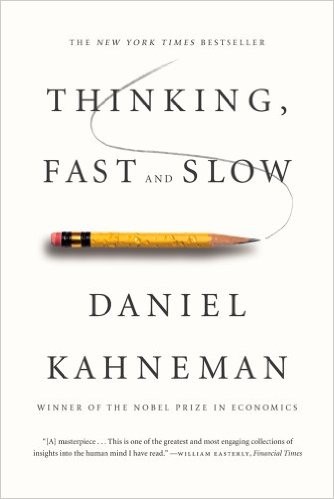
Thinking, Fast and Slow by Daniel Kahneman is a 2011 psychology book about cognitive bias, decision-making, behavioral economics. Two systems govern thought: System 1 is fast, automatic, and associative; System 2 is slow, deliberate, and effortful. Most of our decisions are System 1 in disguise.
Summary
Thinking, Fast and Slow is Daniel Kahneman's account of the two cognitive systems that govern human thought. System 1 operates automatically and quickly — it recognizes faces, reads emotions, and jumps to conclusions with minimal effort. System 2 is slower, deliberate, and effortful — it handles complex arithmetic, careful reasoning, and situations where System 1's shortcuts are likely to mislead. Kahneman's central argument is that we are far more System 1 creatures than we believe ourselves to be, and that this mismatch between self-image and reality explains much of the predictable irrationality in human judgment.
The book tours a remarkable catalog of cognitive biases. Anchoring makes us over-rely on the first number we encounter. Availability makes us overestimate the probability of vivid, easily recalled events. The planning fallacy leads individuals and organizations to chronically underestimate time and cost. Overconfidence is perhaps the most damaging of all: Kahneman draws on decades of research to show that experts in many fields are far less accurate than they believe, and that markets, forecasters, and individuals routinely confuse noise for signal. The distinction between what Kahneman calls the experiencing self and the remembering self — the observation that we don't actually evaluate our lives as they are lived but as they are later recalled and summarized — is among the book's most unsettling findings.
Kahneman also covers prospect theory, the framework he developed with Amos Tversky that earned him the Nobel Prize in Economics. Losses loom larger than equivalent gains. People are risk-seeking when framing a choice as avoiding a loss and risk-averse when framing it as capturing a gain. These patterns are not cultural quirks — they appear across populations and resist correction even when people are warned about them. The implications for public policy, medicine, finance, and personal choice are extensive, and Kahneman does not shy away from laying them out.
The book is long and dense in places. Readers looking for a quick self-help framework will find Kahneman's tone more scientific than prescriptive — he is more interested in documenting the failures of human reasoning than in offering fixes. That honesty is also the book's main virtue: it does not oversell its conclusions. What stays with most readers is not a system for better decisions but a durable habit of noticing when System 1 is doing the driving.
Talk to Thinking, Fast and Slow like its author wrote you back.
Get the ideas that fit your life — not generic summaries.
- Chat with the book
- Audiobook-style main ideas
- Adapts to your life and goals
- Helps you take action
Key takeaways
- 1.
Two systems govern thought: System 1 is fast, automatic, and associative; System 2 is slow, deliberate, and effortful. Most of our decisions are System 1 in disguise.
- 2.
Cognitive biases are not random errors — they are systematic and predictable. Knowing about them reduces but does not eliminate their influence.
- 3.
Anchoring is powerful and ubiquitous. The first number you hear in any negotiation or estimate sets a reference point that skews every subsequent judgment.
- 4.
The availability heuristic makes vivid, memorable events feel more common than they are. Plane crashes dominate risk perception; slow killers like sedentary habits do not.
- 5.
Prospect theory shows that losses loom about twice as large as equivalent gains. Framing a choice as avoiding a loss rather than capturing a gain shifts behavior substantially.
- 6.
Overconfidence is endemic. Experts across fields — stock analysts, clinical psychologists, military strategists — regularly display less accuracy than they claim and less than simple statistical models.
- 7.
The experiencing self and the remembering self are different systems with different agendas. We optimize for memory, not moment-to-moment experience, which distorts how we evaluate our lives.
- 8.
The planning fallacy is near-universal: people consistently underestimate the time, costs, and risks of future projects while overestimating benefits. The cure is using base rates from similar past projects.
Discussion questions
Use these on your own, with a book club, or as chat starters in Superbook. Book club version, ready to copy or print →
- 1.
Kahneman argues that System 1 runs most of our decisions without our awareness. What's a recent decision you made quickly that might have benefited from System 2 engagement?
- 2.
Which cognitive bias from the book do you think has had the biggest practical effect on your financial or career decisions?
- 3.
The anchoring effect suggests that opening numbers in negotiations matter enormously. How has anchoring shaped your behavior as a buyer or seller?
- 4.
Kahneman distinguishes the experiencing self from the remembering self. Think of a vacation or project that was difficult throughout but ended well. Did the ending change how you evaluate the whole experience?
- 5.
The book argues that experts are far less reliable than they think. In what domain do you place trust in expert opinion that this research might cause you to reconsider?
- 6.
Prospect theory says losses feel about twice as heavy as gains. Can you identify a decision you avoided not because the upside was small but because the framing emphasized what you might lose?
- 7.
Kahneman says humans are pattern-seeking to a fault — we construct narratives from noise. Where in your professional life do you see this most clearly?
- 8.
The planning fallacy affects organizations as much as individuals. Does your team or company systematically underestimate project timelines? What would it take to use base rates more honestly?
- 9.
Kahneman is skeptical that knowing about biases does much to prevent them. Do you agree? Has reading about a bias ever noticeably changed your behavior in the moment?
- 10.
The book describes regression to the mean — extreme performances tend to be followed by more average ones. How does this affect how we should praise or criticize people at work or in parenting?
- 11.
The availability heuristic makes us overweight rare, dramatic risks and underweight common, dull ones. Which risks in your own life do you think you are systematically mis-ranking?
- 12.
Kahneman and Tversky's collaboration is described as unusually productive and eventually strained. What does their relationship suggest about how intellectual partnerships work?
Themes
Frequently asked questions
-
Is Thinking, Fast and Slow worth reading?
Yes, if you want to understand the research behind concepts like anchoring, loss aversion, and overconfidence rather than just the pop-science summary. It is dense in places and does not offer simple fixes. Readers who want a lighter introduction to behavioral economics might start with Predictably Irrational and come back to Kahneman later.
-
How long does it take to read Thinking, Fast and Slow?
Around eight to nine hours at average reading pace for the 499-page book. The chapters vary considerably in density. The early sections on heuristics read quickly; the chapters on prospect theory and the two selves reward slower reading and some re-reading.
-
What is the main idea of Thinking, Fast and Slow?
That human thinking runs on two systems: a fast, automatic System 1 that handles most of daily life, and a slow, deliberate System 2 that we believe we use more than we do. The gap between the two explains most cognitive biases and systematic errors in judgment.
-
Who should read this book?
Anyone making consequential decisions — in business, medicine, policy, or investing — who wants to understand why intelligent people make predictable errors. It is especially valuable for managers, analysts, and anyone who evaluates expertise or forecasts.
-
What is the most actionable idea in the book?
The outside view: before estimating how long a project will take or how likely a plan is to succeed, find the base rate from comparable past cases and weight it heavily. Most planning errors come from ignoring this information in favor of optimistic internal narratives.
-
How does this book differ from Blink by Malcolm Gladwell?
Blink celebrates fast, intuitive thinking as a source of reliable wisdom. Kahneman's book is a systematic corrective: it documents when and why intuition fails, and why the cases where it works tend to involve narrow domains with fast feedback loops, not the broad life decisions where people most want to trust their gut.
Similar books
Predictably Irrational
Dan Ariely
Nudge: Improving Decisions About Health, Wealth, and Happiness
Richard H. Thaler and Cass R. Sunstein
Blink: The Power of Thinking Without Thinking
Malcolm Gladwell
The Black Swan: The Impact of the Highly Improbable
Nassim Nicholas Taleb
Thinking, Fast and Slow vs.
Deciding between two books? Thinking, Fast and Slow vs Predictably Irrational .
