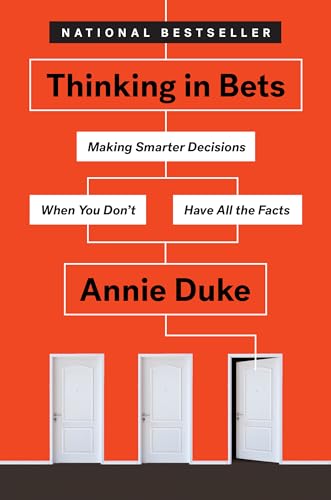
Talk to Thinking in Bets: Making Smarter Decisions When You Don't Have All the Facts like its author wrote you back.
Get the ideas that fit your life — not generic summaries.
- Chat with the book
- Audiobook-style main ideas
- Adapts to your life and goals
- Helps you take action
What it argues
Thinking in Bets is Annie Duke's argument that most decisions in life share a fundamental feature with poker hands: you're choosing under uncertainty, with incomplete information, and luck will affect the outcome regardless of how well you reasoned. Duke spent two decades as one of the highest-earning professional poker players before becoming a decision-making consultant, and the book draws directly on that experience. The central claim is that we evaluate decisions by their outcomes — a habit she calls "resulting" — and that this conflates luck with skill in ways that make us worse at learning from experience.
Duke introduces the concept of "thinking in bets," which means assigning explicit probabilities to beliefs rather than treating them as either true or false. When you say "I believe X," you're making a claim that should have a confidence level attached to it. Updating those confidence levels when evidence arrives is rational; holding them firm because admitting uncertainty feels like weakness is not. The book also dissects how we process wins and losses differently — we take personal credit for good outcomes and blame circumstances for bad ones — and how peer groups either reinforce this pattern or help us break it.
What it gets right
- 1.
Resulting is the error of judging a decision by its outcome rather than the quality of the reasoning behind it. Good decisions can lead to bad outcomes and bad decisions can get lucky.
- 2.
All decisions are bets. Treating beliefs as having a probability — "I'm about 70% confident" — is more honest and more useful than the binary "I know" or "I don't know."
- 3.
Hindsight bias rewrites memory. After an outcome, we unconsciously update our recollection of what we expected, which makes it nearly impossible to learn accurately from experience.
What it covers
Who wrote it
Annie Duke is a former professional poker player who won more than $4 million in tournament poker and is the only woman to have won the World Series of Poker Tournament of Champions. She holds an undergraduate degree from Columbia and did graduate work in cognitive psychology at the University of Pennsylvania before leaving academia for poker. Since retiring from the game she has worked as a decision-making consultant for businesses and written two books: Thinking in Bets (2018) and Quit: The Power of Knowing When to Walk Away (2022).
