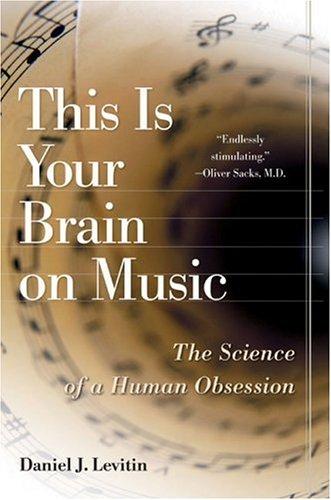
Talk to This Is Your Brain on Music: The Science of a Human Obsession like its author wrote you back.
Get the ideas that fit your life — not generic summaries.
- Chat with the book
- Audiobook-style main ideas
- Adapts to your life and goals
- Helps you take action
What it argues
Daniel Levitin came to neuroscience from the music industry — he was a record producer who worked with Stevie Wonder, the Grateful Dead, and Blue Öyster Cult before getting a PhD in psychology and cognitive neuroscience. That background shapes everything about this book. Levitin writes about music from the inside, and the result is an account of what's actually happening in the brain when music moves you that's simultaneously scientifically grounded and emotionally literate.
The book covers a broad sweep of territory. The early chapters establish vocabulary: what pitch, timbre, rhythm, tempo, contour, loudness, and spatial location mean both acoustically and perceptually. Levitin is careful to distinguish between the physical properties of sound and how the brain processes them — the two don't always align, and the discrepancies are revealing. The chapter on expectation is particularly strong. Music works partly by establishing patterns and then fulfilling, violating, or delaying them in ways that trigger the brain's reward circuitry. The surprise in a chord change and the satisfaction of a resolution are not metaphors; they're the outputs of a prediction system the brain runs automatically.
What it gets right
- 1.
Music perception is active, not passive. The brain continuously generates predictions about what comes next, and the pleasure of music comes partly from how those predictions are confirmed or violated.
- 2.
Pitch, timbre, rhythm, tempo, and loudness are distinct perceptual dimensions, each processed by different neural circuits. What we call 'music' is the simultaneous interaction of all of them.
- 3.
The brain responds to musical expectation and resolution using the same reward circuitry involved in food, sex, and drug response. The chills or 'frisson' of a musical moment are measurable neurochemical events.
What it covers
Who wrote it
Daniel J. Levitin is a neuroscientist, musician, and author who served as a record producer and sound engineer before completing a PhD in psychology at the University of Oregon. He is a professor emeritus at McGill University and a faculty member at the Minerva Schools. His research examines music perception, memory, and cognitive neuroscience. He is the author of several books including The World in Six Songs and Successful Aging. Before academia he worked with artists including Stevie Wonder, the Grateful Dead, Chris Isaak, and Santana. He plays guitar, bass, and keyboards.
