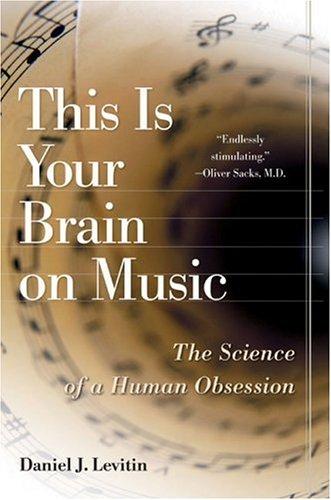
This Is Your Brain on Music: The Science of a Human Obsession by Daniel J. Levitin is a 2006 science book about music, neuroscience, perception. Music perception is active, not passive. The brain continuously generates predictions about what comes next, and the pleasure of music comes partly from how those predictions are confirmed or violated.
Summary
Daniel Levitin came to neuroscience from the music industry — he was a record producer who worked with Stevie Wonder, the Grateful Dead, and Blue Öyster Cult before getting a PhD in psychology and cognitive neuroscience. That background shapes everything about this book. Levitin writes about music from the inside, and the result is an account of what's actually happening in the brain when music moves you that's simultaneously scientifically grounded and emotionally literate.
The book covers a broad sweep of territory. The early chapters establish vocabulary: what pitch, timbre, rhythm, tempo, contour, loudness, and spatial location mean both acoustically and perceptually. Levitin is careful to distinguish between the physical properties of sound and how the brain processes them — the two don't always align, and the discrepancies are revealing. The chapter on expectation is particularly strong. Music works partly by establishing patterns and then fulfilling, violating, or delaying them in ways that trigger the brain's reward circuitry. The surprise in a chord change and the satisfaction of a resolution are not metaphors; they're the outputs of a prediction system the brain runs automatically.
The middle section moves into memory, emotion, and the evolutionary debate about music. Levitin surveys the evidence on music and memory — why songs from adolescence feel emotionally different from songs heard in adulthood, why Alzheimer's patients who lose language and recognition often retain musical memory, and why music can retrieve emotional states attached to specific events. The evolutionary question — whether music is an adaptation or a byproduct of other adaptations — gets a fair treatment, with Levitin leaning toward adaptation while acknowledging the debate isn't settled.
The book has limits. Some sections covering expert performance and genetics are less compelling than the core neuroscience chapters. Readers with advanced musical training may find early vocabulary sections slow. But as an introduction to the science of music perception for a general reader, it's the most accessible and thorough available, and Levitin's genuine love for the subject comes through on every page.
Talk to This Is Your Brain on Music: The Science of a Human Obsession like its author wrote you back.
Get the ideas that fit your life — not generic summaries.
- Chat with the book
- Audiobook-style main ideas
- Adapts to your life and goals
- Helps you take action
Key takeaways
- 1.
Music perception is active, not passive. The brain continuously generates predictions about what comes next, and the pleasure of music comes partly from how those predictions are confirmed or violated.
- 2.
Pitch, timbre, rhythm, tempo, and loudness are distinct perceptual dimensions, each processed by different neural circuits. What we call 'music' is the simultaneous interaction of all of them.
- 3.
The brain responds to musical expectation and resolution using the same reward circuitry involved in food, sex, and drug response. The chills or 'frisson' of a musical moment are measurable neurochemical events.
- 4.
Musical memory is stored differently from other kinds of long-term memory and is often more robust. Songs from adolescence carry strong emotional valence because of how memory consolidation and identity formation overlap during that period.
- 5.
Absolute pitch — the ability to identify notes without a reference tone — is likely a combination of genetic predisposition and early exposure. It's rare partly because of when exposure needs to happen.
- 6.
The evolutionary debate about music is unresolved. Levitin argues music is an adaptation, not a byproduct of language, based partly on its ancient and universal presence across cultures.
- 7.
Expertise in music is largely practice-based. Studies suggest roughly ten thousand hours of deliberate practice separate expert from novice performers across instruments.
- 8.
Music communicates emotion reliably across cultures. Certain tonal and rhythmic patterns elicit consistent emotional responses even in listeners unfamiliar with the musical tradition.
Discussion questions
Use these on your own, with a book club, or as chat starters in Superbook. Book club version, ready to copy or print →
- 1.
Levitin argues that music works partly through the brain's prediction system. Think of a song that gives you physical chills. Can you identify the specific moment of expectation violation or resolution that triggers it?
- 2.
Why do songs from your adolescence feel emotionally different from songs you hear now? Based on what Levitin describes about memory, does this make sense?
- 3.
The book is partly a defense of music as an evolutionary adaptation. Do you find the evolutionary argument convincing? What would need to be true for music to be merely a byproduct?
- 4.
Levitin describes how Alzheimer's patients retain musical memory long after losing other kinds. What does this suggest about how music is stored relative to language and episodic memory?
- 5.
Think of a piece of music that reliably changes your mood. Is the effect consistent, or does it depend on the context?
- 6.
Levitin comes from the music industry before neuroscience. How does his background shape what he notices about music versus what a pure scientist might emphasize?
- 7.
The ten-thousand-hours concept appears here in the context of musical expertise. Does the way Levitin presents expertise research change how you think about your own skills or learning?
- 8.
If musical expectation is part of why music is pleasurable, does familiarity with a genre train you to appreciate it more? Have you experienced this?
- 9.
Levitin argues that music communicates emotion across cultures. Can you think of a piece from an unfamiliar musical tradition that moved you? What made it accessible?
- 10.
What would it mean if music is hardwired into human cognition? Does that change how you think about music education, or its place in child development?
- 11.
The book was published in 2006. What has changed in music listening — streaming, algorithmic recommendation, headphone culture — that Levitin couldn't have anticipated, and how might it affect the neuroscience he describes?
- 12.
Levitin wrote this book as both a scientist and a music industry veteran. Where do you notice those two perspectives pulling in different directions?
Themes
Frequently asked questions
-
What is This Is Your Brain on Music about?
It's a neuroscientist-and-musician's account of what happens in the brain when you listen to music. Levitin covers pitch perception, musical memory, the role of expectation in emotional response, evolutionary debates about music's origins, and the neuroscience of expertise in performance.
-
Is This Is Your Brain on Music worth reading?
Yes, particularly if you love music and want to understand why it works on you the way it does. Levitin writes accessibly and the science is solid. Some sections on genetics and expert performance are weaker, but the core chapters on perception and emotion are outstanding.
-
Do I need a background in music theory to read this book?
No. Levitin defines all technical terms and the vocabulary sections are written for non-musicians. Readers with music training may find the early chapters slower but will likely appreciate the depth of engagement with acoustic and perceptual science.
-
How long is This Is Your Brain on Music?
Around 320 pages, roughly six hours at average reading pace. The chapters on expectation and memory reward slow reading and re-reading.
-
What's the most surprising finding in the book?
The robustness of musical memory in Alzheimer's patients stands out. Levitin describes cases where patients who can no longer recognize family members or form new memories still respond to and remember music from their past. It's evidence that music is stored in a different and more durable way than episodic memory.
Similar books
The Enigma of Reason
Hugo Mercier and Dan Sperber
Incognito: The Secret Lives of the Brain
David Eagleman

Seven and a Half Lessons About the Brain
Lisa Feldman Barrett
A Short History of Nearly Everything
Bill Bryson
