Talk to To Sell Is Human like its author wrote you back.
Get the ideas that fit your life — not generic summaries.
- Chat with the book
- Audiobook-style main ideas
- Adapts to your life and goals
- Helps you take action
To Sell Is Human, in detail
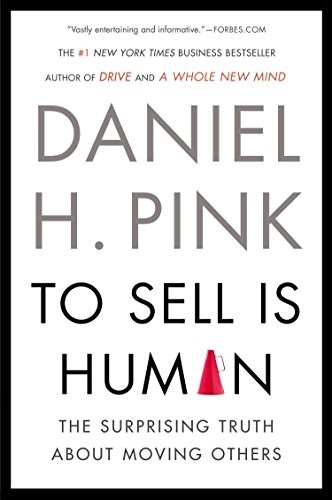
To Sell Is Human is Daniel Pink's case that selling — in the broad sense of moving people to think or act differently — is central to what most of us do at work every day, whether or not our job title includes the word "sales." Drawing on Bureau of Labor Statistics data, Pink estimates that Americans spend roughly 40% of their work time in non-sales selling: persuading, convincing, and nudging. Teachers sell ideas to students. Lawyers sell arguments to judges. Entrepreneurs sell visions to investors. His framework treats all of this as a single category worth examining.
The book opens by dismantling the old model of sales: the era of "Always Be Closing," asymmetric information, and the pushy car salesman. Pink argues that buyers now have more access to information than sellers in many markets, inverting the traditional dynamic. The tactics that worked when sellers knew more than buyers — high pressure, withholding information, manufactured urgency — actively backfire in a world where a prospect can find your competitor's price and your customer reviews in thirty seconds. The new model, Pink argues, requires honesty, transparency, and the ability to understand the other person's situation rather than manipulate it.
The middle of the book introduces three new ABCs: Attunement (reading the room, seeing from the other person's perspective), Buoyancy (staying afloat through rejection — Pink cites Martin Seligman's work on explanatory style, the idea that optimists explain bad events as temporary, local, and external), and Clarity (helping people see their situation differently rather than just providing more information). He then applies these to specific selling contexts — pitching, presenting, making sense of complex problems.
Pink is a capable synthesizer. He draws on research in behavioral economics, psychology, and sales performance without getting technical. The book's weakness is that it can feel simultaneously broad and light: if you've read Drive or any Gladwell, some of the research-to-anecdote structure will feel familiar. But the reframe of selling as fundamentally human and universal is genuinely useful, particularly for people who would never describe themselves as salespeople but spend much of their time trying to move others.
The big ideas
- 1.
Roughly 40% of the average knowledge worker's time involves non-sales selling: persuading, convincing, and changing minds without a formal sales role.
- 2.
The information asymmetry that gave sellers power over buyers has largely collapsed. Buyers can verify claims instantly, which makes honesty the new competitive advantage.
- 3.
The new ABCs of selling: Attunement (perspective-taking), Buoyancy (resilience through rejection), and Clarity (reframing the prospect's problem).
