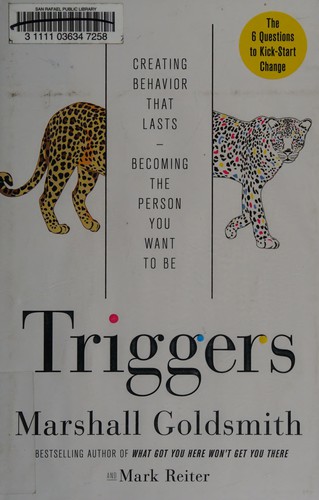
Talk to Triggers like its author wrote you back.
Get the ideas that fit your life — not generic summaries.
- Chat with the book
- Audiobook-style main ideas
- Adapts to your life and goals
- Helps you take action
Triggers, in detail
Triggers is Marshall Goldsmith's examination of why behavioral change is so persistently difficult, even for intelligent, self-aware people who genuinely want to change. The central insight is that the environment triggers behavior constantly and mostly without our awareness — and that the gap between who we intend to be and who we actually are at any given moment is largely a function of environmental triggers acting on us before we can exercise deliberate choice.
Goldsmith identifies the categories of triggers: environmental cues that produce automatic behavioral responses, organizational pressures that compromise values under stress, interpersonal dynamics that bring out the worst in us, and our own beliefs about why change is unnecessary or impossible. He is particularly incisive on the self-beliefs that block change: "I have too much on my mind to change," "I won't be able to sustain the change," "I didn't create this problem," "The problem is not that bad."
The practical centerpiece of the book is the Daily Questions practice: at the end of each day, asking yourself a set of active questions that track the behaviors you care most about changing. The critical word is "active" — not "Did I do my best today?" but "Did I do my best to be happy today?" The active framing places responsibility on the questioner rather than on circumstances, and the daily tracking creates accountability that self-awareness alone never produces.
The book is a complement to What Got You Here Won't Get You There rather than a replacement. Where the earlier book focused on the twenty habits to stop, Triggers focuses on the environmental dynamics that make stopping those habits harder than it should be, and on the specific daily practice that produces the consistency that insight alone cannot.
The big ideas
- 1.
The environment triggers behavior constantly and mostly unconsciously. Lasting change requires designing your environment, not just forming intentions.
- 2.
The gap between who we want to be and who we are is largely a function of triggers acting on us before we've exercised conscious choice.
- 3.
The six beliefs that block change: I have too much on my mind, I won't be able to sustain it, I don't need to change, the problem isn't that bad, my colleagues need to change first, and I'll deal with it later.
