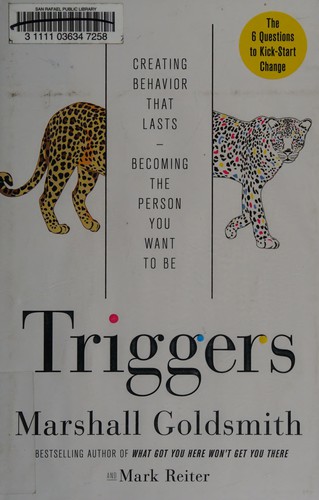
Triggers by Marshall Goldsmith is a 2015 business book about behavior change, self-awareness, leadership. The environment triggers behavior constantly and mostly unconsciously. Lasting change requires designing your environment, not just forming intentions.
Summary
Triggers is Marshall Goldsmith's examination of why behavioral change is so persistently difficult, even for intelligent, self-aware people who genuinely want to change. The central insight is that the environment triggers behavior constantly and mostly without our awareness — and that the gap between who we intend to be and who we actually are at any given moment is largely a function of environmental triggers acting on us before we can exercise deliberate choice.
Goldsmith identifies the categories of triggers: environmental cues that produce automatic behavioral responses, organizational pressures that compromise values under stress, interpersonal dynamics that bring out the worst in us, and our own beliefs about why change is unnecessary or impossible. He is particularly incisive on the self-beliefs that block change: "I have too much on my mind to change," "I won't be able to sustain the change," "I didn't create this problem," "The problem is not that bad."
The practical centerpiece of the book is the Daily Questions practice: at the end of each day, asking yourself a set of active questions that track the behaviors you care most about changing. The critical word is "active" — not "Did I do my best today?" but "Did I do my best to be happy today?" The active framing places responsibility on the questioner rather than on circumstances, and the daily tracking creates accountability that self-awareness alone never produces.
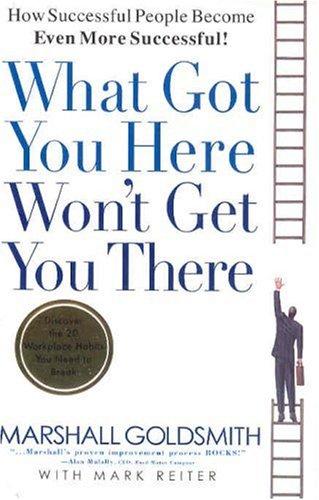
The book is a complement to What Got You Here Won't Get You There rather than a replacement. Where the earlier book focused on the twenty habits to stop, Triggers focuses on the environmental dynamics that make stopping those habits harder than it should be, and on the specific daily practice that produces the consistency that insight alone cannot.
Talk to Triggers like its author wrote you back.
Get the ideas that fit your life — not generic summaries.
- Chat with the book
- Audiobook-style main ideas
- Adapts to your life and goals
- Helps you take action
Key takeaways
- 1.
The environment triggers behavior constantly and mostly unconsciously. Lasting change requires designing your environment, not just forming intentions.
- 2.
The gap between who we want to be and who we are is largely a function of triggers acting on us before we've exercised conscious choice.
- 3.
The six beliefs that block change: I have too much on my mind, I won't be able to sustain it, I don't need to change, the problem isn't that bad, my colleagues need to change first, and I'll deal with it later.
- 4.
Daily Questions use active framing: 'Did I do my best to [X]?' rather than 'Did I [X]?' The active framing places agency with you, not with circumstances.
- 5.
Consistent daily tracking produces behavioral change through accountability to yourself. Measurement alone — without judgment — changes behavior.
- 6.
The environments we can't control trigger us most. Managing how you respond to uncontrollable triggers is the core discipline of emotional self-regulation.
- 7.
Our identity beliefs often work against change: 'I'm not the kind of person who...' is both a self-description and a prediction that limits what we attempt.
- 8.
Behavioral change requires immediate feedback loops. The longer the lag between action and consequence, the less likely the behavior is to change.
Discussion questions
Use these on your own, with a book club, or as chat starters in Superbook. Book club version, ready to copy or print →
- 1.
What's the most reliable trigger in your environment for your worst leadership behavior? Is it a person, a situation, a time of day?
- 2.
Goldsmith lists six beliefs that block change. Which one is most active in you right now, about something you know you should change?
- 3.
Draft three Daily Questions for yourself — active questions about behaviors you genuinely want to change. Would you commit to asking them every evening for a month?
- 4.
What environment changes could you make — physical, organizational, or social — that would make your desired behavior easier and your undesired behavior harder?
- 5.
The book argues that knowing what to do and doing it consistently are completely different problems. What's something you know exactly how to do that you still don't do consistently? What's the trigger you haven't accounted for?
- 6.
Think about a person who reliably brings out the worst in you. What specifically happens in interactions with them? What could you do before those interactions to manage the trigger?
- 7.
How much of your organizational behavior do you attribute to your own choices versus to the environment around you? Is that attribution accurate?
- 8.
Goldsmith says measurement alone changes behavior. What would happen if you tracked one leadership behavior every day for thirty days — even without a plan to change it?
- 9.
What's an identity belief — 'I'm not the kind of person who...' — that might be limiting your growth as a leader?
- 10.
The Daily Questions practice requires daily discipline. What practices do you maintain consistently? What makes those sustainable when so many others don't stick?
- 11.
Goldsmith uses the concept of 'AIWATT' — Am I Willing At This Time to make the investment to make a change? Apply this honestly to one change you've been considering.
Themes
Frequently asked questions
-
Is Triggers worth reading if I've already read What Got You Here Won't Get You There?
Yes — they address different parts of the same problem. What Got You Here identifies specific behaviors to change; Triggers explains why changing them is hard and offers the Daily Questions methodology as a practical tool. The two books together are more complete than either alone.
-
How long does it take to read Triggers?
Around four hours for the 240-page book. Goldsmith writes accessibly and the chapters are short, making it a quick read.
-
What are the Daily Questions, and do they actually work?
They're a set of active questions you ask yourself each evening about the behaviors you're working to change. 'Did I do my best to be fully engaged today?' rather than 'Was I fully engaged today?' Goldsmith presents client data suggesting that daily self-questioning produces measurable behavioral change even when no other interventions are used.
-
Who should read Triggers?
Leaders who've received feedback about their behavior and want to understand why change hasn't stuck despite awareness and intention. Also useful for anyone who's tried to build better habits and failed repeatedly, and wants a framework for why the environment keeps winning.
-
What's the most actionable idea in Triggers?
The Daily Questions practice: write three to six active questions about the behaviors you most want to change, and answer them every evening with a number from one to ten. Do this for thirty days and notice what happens. It's simple, free, and the evidence Goldsmith presents is compelling.