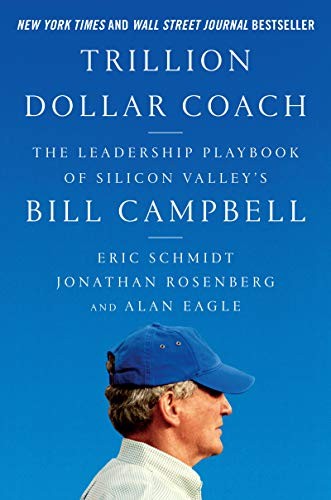
Talk to Trillion Dollar Coach like its author wrote you back.
Get the ideas that fit your life — not generic summaries.
- Chat with the book
- Audiobook-style main ideas
- Adapts to your life and goals
- Helps you take action
What it argues
Trillion Dollar Coach is a tribute to Bill Campbell, the former football coach and Columbia University athletic director who became the most influential executive coach in Silicon Valley — coaching Steve Jobs, Eric Schmidt, Sheryl Sandberg, Jeff Bezos, and the co-founders of Google, among others. Campbell died in 2016, and this book is the account that Eric Schmidt, Jonathan Rosenberg, and Alan Eagle assembled from interviews with over eighty people Campbell coached or worked with.
The book is organized around the principles Campbell practiced rather than a narrative of his life. The central theme is that Campbell's approach to leadership was relentlessly human: he cared about the person first, the role second. He started every meeting by asking about family, health, and personal wellbeing — not as a warm-up before the real conversation but because he genuinely believed that people who felt cared for performed better and made better decisions. He also believed that the team is the unit that matters, and that the leader's job is to make the team great rather than to be great themselves.
What it gets right
- 1.
The team is the unit of performance, not the individual. The leader's job is to build and maintain a great team, not to be the smartest person in the room.
- 2.
Caring about the person behind the role — their family, health, and wellbeing — is not a distraction from performance. It's the precondition for the trust that enables honest conversations.
- 3.
Honesty is a form of respect. Giving people honest assessments of their performance, delivered with care, is how you honor the seriousness of their work and their potential.
What it covers
Who wrote it
Eric Schmidt served as CEO of Google from 2001 to 2011 and as executive chairman until 2017. Jonathan Rosenberg was Senior Vice President of Products at Google and is now an advisor to Alphabet. Alan Eagle is a director of communications and author at Alphabet and previously at Google. The three worked together closely at Google, where Bill Campbell was a board member and the informal coach of the leadership team. They assembled this account of Campbell's coaching philosophy from interviews with eighty people he coached or worked with during his decades in Silicon Valley.
