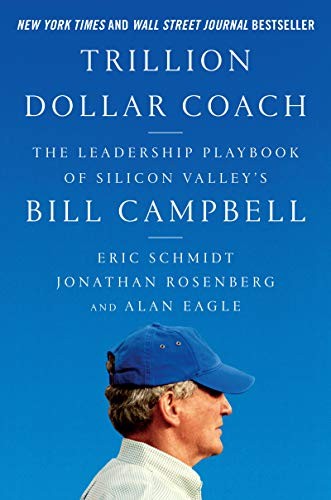
Trillion Dollar Coach by Eric Schmidt, Jonathan Rosenberg, and Alan Eagle is a 2019 business book about coaching, leadership, team building. The team is the unit of performance, not the individual. The leader's job is to build and maintain a great team, not to be the smartest person in the room.
Summary
Trillion Dollar Coach is a tribute to Bill Campbell, the former football coach and Columbia University athletic director who became the most influential executive coach in Silicon Valley — coaching Steve Jobs, Eric Schmidt, Sheryl Sandberg, Jeff Bezos, and the co-founders of Google, among others. Campbell died in 2016, and this book is the account that Eric Schmidt, Jonathan Rosenberg, and Alan Eagle assembled from interviews with over eighty people Campbell coached or worked with.
The book is organized around the principles Campbell practiced rather than a narrative of his life. The central theme is that Campbell's approach to leadership was relentlessly human: he cared about the person first, the role second. He started every meeting by asking about family, health, and personal wellbeing — not as a warm-up before the real conversation but because he genuinely believed that people who felt cared for performed better and made better decisions. He also believed that the team is the unit that matters, and that the leader's job is to make the team great rather than to be great themselves.
Campbell's coaching practice is captured in a set of behaviors: fierce loyalty to the people he worked with, radical candor delivered with warmth, belief in high standards that wasn't accompanied by micromanagement, and consistent insistence that people needed to hear honest assessments of their performance because they deserved the chance to improve. He was also famous for the directness with which he handled conflict — surfacing disagreements explicitly rather than allowing them to fester.
The book is not a how-to manual but a portrait. It captures a specific person's way of being with leaders rather than a transferable system. That's appropriate: Campbell's influence came from who he was more than from any technique, and the authors are honest about that. The result is more useful as a model for reflection on what good coaching means than as a prescription.
Talk to Trillion Dollar Coach like its author wrote you back.
Get the ideas that fit your life — not generic summaries.
- Chat with the book
- Audiobook-style main ideas
- Adapts to your life and goals
- Helps you take action
Key takeaways
- 1.
The team is the unit of performance, not the individual. The leader's job is to build and maintain a great team, not to be the smartest person in the room.
- 2.
Caring about the person behind the role — their family, health, and wellbeing — is not a distraction from performance. It's the precondition for the trust that enables honest conversations.
- 3.
Honesty is a form of respect. Giving people honest assessments of their performance, delivered with care, is how you honor the seriousness of their work and their potential.
- 4.
Disagreements must be surfaced and resolved explicitly. Campbell was famous for identifying when two people were avoiding a conflict and creating space for them to have it directly.
- 5.
The best coaches are people lovers who believe deeply in human potential. Technical knowledge of the domain helps, but genuine care for people is more important.
- 6.
Psychological safety at the team level requires that members trust each other enough to argue vigorously and then commit fully to whatever was decided.
- 7.
Your title makes you a manager; your people make you a leader. Campbell consistently distinguished between the authority of position and the authority earned through relationship and results.
- 8.
A great coach's impact is measured by the performance of the people they coached, not by their own profile. Campbell was famously comfortable being the hidden hand behind others' success.
Discussion questions
Use these on your own, with a book club, or as chat starters in Superbook. Book club version, ready to copy or print →
- 1.
Campbell started meetings by asking about family and wellbeing. How much do you know about the personal lives of the people you work most closely with? Does it matter?
- 2.
The book says Campbell's value was invisible — he was a hidden hand behind many of Silicon Valley's most celebrated leaders. How do you feel about that kind of invisible impact? Is it compelling or unsatisfying?
- 3.
Campbell was famous for surfacing avoided conflicts explicitly. Is there a conflict in your organization right now that is being managed around rather than resolved? What's the cost?
- 4.
He distinguished between your title making you a manager and your people making you a leader. Where in your organization do people have the title without having the earned authority?
- 5.
The book argues the team is the unit of performance. What's the structural difference between a team where the leader is the star and a team where the team is the star?
- 6.
Campbell gave honest assessments because he believed people deserved the chance to improve. How does this differ from harsh feedback? What makes honesty feel like care rather than criticism?
- 7.
Many of the people Campbell coached became world-class leaders. Is that replicable? What was transferable about his approach and what was specific to who he was?
- 8.
What does a great coach provide that a great manager doesn't? Is the distinction useful, or are they the same thing done well?
- 9.
Campbell worked with people who were already at the top — CEOs and founders. Is the coaching model described here applicable to earlier-career people, or is it specifically suited to those who've already proven themselves?
- 10.
What would change in your organization if every leader had access to the kind of coaching relationship Campbell provided?
- 11.
The book is written by people who loved Campbell and want to honor him. Does that context affect how much you trust its account of his approach?
Themes
Frequently asked questions
-
Is Trillion Dollar Coach worth reading?
Yes, particularly if you want a vivid portrait of what great coaching looks like in practice rather than in the abstract. The book is more memoir than framework, but the principles are clearly articulated and the case studies are rich. Campbell's emphasis on team first and care second are genuinely instructive.
-
How long does it take to read Trillion Dollar Coach?
Around four hours for the 238-page book. It's written in clear, accessible prose and organized thematically rather than chronologically, making it a quick read.
-
What made Bill Campbell different from other executive coaches?
Primarily his genuine care for people and his willingness to give honest assessments without pulling punches. He was not a consultant selling a methodology; he was a person who loved the people he worked with and believed in them enough to tell them hard truths. The combination of warmth and honesty is rarer than either alone.
-
Who should read Trillion Dollar Coach?
Leaders at any level who want to understand what great coaching looks like, anyone interested in the culture of Silicon Valley and the personal dynamics behind its most successful companies, and managers who want a concrete model of someone who led through relationships rather than authority.
-
What's the most important idea in the book?
That people come first — not as a platitude but as an operational commitment. Campbell spent the first part of every coaching conversation asking about personal wellbeing because he understood that the person and the executive are not separable. Most management frameworks treat the human element as soft; Campbell treated it as foundational.