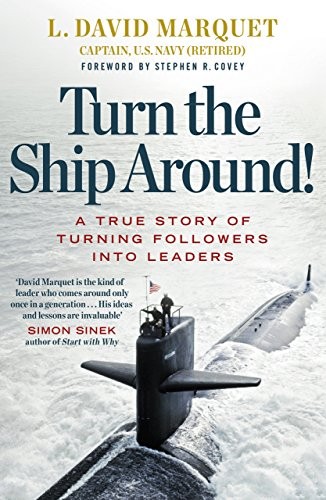
Talk to Turn the Ship Around! like its author wrote you back.
Get the ideas that fit your life — not generic summaries.
- Chat with the book
- Audiobook-style main ideas
- Adapts to your life and goals
- Helps you take action
What it argues
Turn the Ship Around! is L. David Marquet's account of transforming the USS Santa Fe from the worst-performing submarine in the US Navy's Pacific Fleet to one of the best — by doing something almost nobody does in a command-and-control hierarchy: giving control to the people closest to the work.
Marquet arrived on the Santa Fe without having trained on that class of submarine. When he issued a technically impossible order and watched his crew execute it anyway without question — because questioning orders isn't the culture — he concluded that the leader-follower model was inherently broken. A crew that doesn't think is a liability, not an asset. He set out to build what he calls a leader-leader organization, where authority is distributed as close to the problem as possible and every person is developing the judgment to act without waiting for permission.
What it gets right
- 1.
Leader-leader organizations outperform leader-follower organizations because they develop judgment at every level rather than concentrating it at the top.
- 2.
Replacing orders with statements of intent shifts cognitive ownership to the person closest to the problem. 'I intend to X' requires understanding the situation, not just obeying a command.
- 3.
Control without competence is chaos. Distributing authority works only when you also invest in building the technical knowledge that makes good autonomous decisions possible.
What it covers
Who wrote it
L. David Marquet is a retired US Navy Captain who served for twenty-eight years, culminating in command of the nuclear-powered submarine USS Santa Fe. His approach to leadership on the Santa Fe attracted wide attention after Stephen Covey included it in a foreword and it was cited as a case study in organizational transformation. After retiring from the Navy, Marquet became a leadership consultant and speaker. He is also the author of Leadership Is Language, which extends the ideas in Turn the Ship Around into a broader linguistic framework for leadership.
