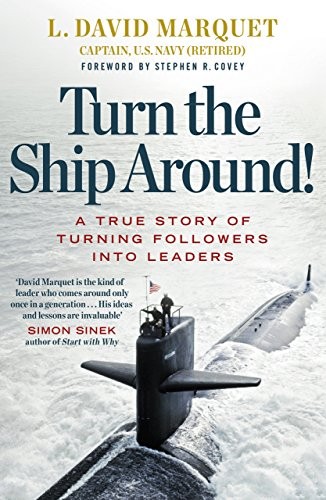
Turn the Ship Around! by L. David Marquet is a 2013 business book about leadership, autonomy, organizational transformation. Leader-leader organizations outperform leader-follower organizations because they develop judgment at every level rather than concentrating it at the top.
Summary
Turn the Ship Around! is L. David Marquet's account of transforming the USS Santa Fe from the worst-performing submarine in the US Navy's Pacific Fleet to one of the best — by doing something almost nobody does in a command-and-control hierarchy: giving control to the people closest to the work.
Marquet arrived on the Santa Fe without having trained on that class of submarine. When he issued a technically impossible order and watched his crew execute it anyway without question — because questioning orders isn't the culture — he concluded that the leader-follower model was inherently broken. A crew that doesn't think is a liability, not an asset. He set out to build what he calls a leader-leader organization, where authority is distributed as close to the problem as possible and every person is developing the judgment to act without waiting for permission.
The mechanism was deceptively simple: instead of orders, the crew stated their intentions. "I intend to submerge the ship" rather than "Permission to submerge the ship." This shifts the cognitive burden from the captain to the crew member, who must understand the situation well enough to own the decision. Over time, the Santa Fe became the submarine that produced the most officers promoted to command — not just a high performer, but a development engine.
The book is organized around the mechanisms Marquet used: eliminating top-down orders, creating a vocabulary of intent, pushing technical competence down the org chart so autonomy doesn't become recklessness, and building a culture where people shout problems up rather than hide them. The writing is part memoir, part leadership manual. The military setting is useful rather than limiting — the stakes make the stakes clear — and the principles translate to any hierarchical organization where people are waiting for permission they should be giving themselves.
Talk to Turn the Ship Around! like its author wrote you back.
Get the ideas that fit your life — not generic summaries.
- Chat with the book
- Audiobook-style main ideas
- Adapts to your life and goals
- Helps you take action
Key takeaways
- 1.
Leader-leader organizations outperform leader-follower organizations because they develop judgment at every level rather than concentrating it at the top.
- 2.
Replacing orders with statements of intent shifts cognitive ownership to the person closest to the problem. 'I intend to X' requires understanding the situation, not just obeying a command.
- 3.
Control without competence is chaos. Distributing authority works only when you also invest in building the technical knowledge that makes good autonomous decisions possible.
- 4.
People who wait for permission develop atrophied judgment. Every time a leader takes a decision that someone lower could handle, they're stunting that person's development.
- 5.
The worst teams have strong top-down leaders and compliant followers. They perform acceptably as long as the leader is present and correct. They fail catastrophically when the leader is absent or wrong.
- 6.
Organizational change has to start with language. Change the words people use to describe what they're doing and you change the thinking that drives the decisions.
- 7.
The goal is not to be needed. A leader who makes themselves indispensable has created a fragile organization, not a strong one.
- 8.
Short, immediate feedback loops — between action and consequence — are how organizations learn. Delay the feedback and you delay the learning.
Discussion questions
Use these on your own, with a book club, or as chat starters in Superbook. Book club version, ready to copy or print →
- 1.
Marquet realized the leader-follower model was broken when his crew executed an impossible order without question. Have you witnessed something similar — a team doing what the boss said rather than what was right?
- 2.
What's the ratio of 'I intend to' thinking to 'what should I do' thinking on your team? What does that ratio tell you about how much decision-making authority has actually been distributed?
- 3.
The book argues that control without competence is dangerous. Are there areas where your team has been given autonomy they don't yet have the knowledge to use well? What would closing that gap require?
- 4.
What decisions do you currently make that someone on your team could and should be making? What's stopping the transfer?
- 5.
Marquet describes building a ship where problems got shouted up rather than hidden. What happens in your organization when something goes wrong? Does it surface quickly or slowly?
- 6.
The Santa Fe became a ship that produced officers — a development engine, not just a high performer. What's your team's record of developing people who go on to lead other teams?
- 7.
Have you ever worked for a leader who was so decisive and competent that the team around them never developed? What were the long-term effects?
- 8.
What would have to change about the language you use at work for the shift from 'asking for permission' to 'stating intentions' to feel natural?
- 9.
The book is set in the military, which has an extreme hierarchy. What's gained and what's lost in translating the leader-leader model to a civilian organization with lower stakes?
- 10.
Marquet says the goal is to not be needed. How comfortable are you with the idea of making yourself unnecessary in your current role?
- 11.
What feedback loops in your organization have significant lag — where the consequences of a decision don't become visible for weeks or months? What does that lag cost?
- 12.
If your organization ran on 'I intend to' instead of 'may I,' what's the first place that would break down, and why?
Themes
Frequently asked questions
-
Is Turn the Ship Around! worth reading?
Yes, especially for leaders who want to move away from top-down control but aren't sure how to do it without creating chaos. The military setting makes the stakes vivid and the mechanisms concrete. The underlying model applies to any organization where people currently wait for permission they should be giving themselves.
-
How long does it take to read Turn the Ship Around?
About four hours for the 226-page book. It reads quickly — the narrative momentum of the Santa Fe story carries the management lessons in a way that makes the reading feel less like work than most leadership books.
-
What's the 'I intend to' mechanism, and does it actually work?
It's a linguistic change: instead of asking for permission, crew members state their intended action and rationale. The shift forces them to actually think through what they're doing rather than waiting for validation. The evidence from the Santa Fe — and from organizations that have applied the model since — suggests it works when paired with genuine investment in developing competence.
-
Who should read Turn the Ship Around?
Leaders at any level who work in organizations where people wait for permission, hide problems, or don't take ownership. Also useful for executives thinking about organizational design and how to push decision-making downward without losing coherence.
-
How does the military context translate to civilian organizations?
The authority gradient in the Navy is more extreme than in most companies, which means the principles about distributing control apply at least as strongly in civilian settings. The places where the translation requires care are where the consequences of mistakes are genuinely irreversible — the nuclear-submarine setting sets a higher bar for competence-before-control than most office environments require.