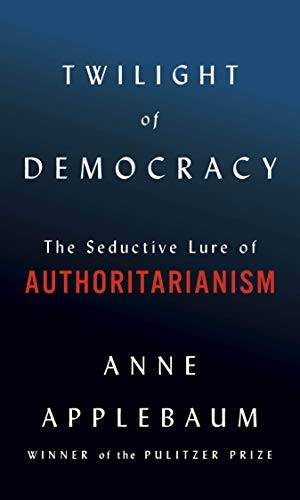
Talk to Twilight of Democracy: The Seductive Lure of Authoritarianism like its author wrote you back.
Get the ideas that fit your life — not generic summaries.
- Chat with the book
- Audiobook-style main ideas
- Adapts to your life and goals
- Helps you take action
What it argues
Anne Applebaum opens Twilight of Democracy with a party she and her husband hosted on New Year's Eve 1999, celebrating the new millennium with a hundred friends and colleagues in Poland. By 2019, when she began writing this book, half of those people were no longer speaking to her — estranged not by personal quarrels but by politics. Many had moved toward authoritarian nationalist parties in Poland, Hungary, the United Kingdom, and the United States. The book is an attempt to understand how that happened.
Applebaum's central argument is that authoritarian movements attract a particular psychological type she calls the "clerisy" — educated, ambitious people who feel that meritocracy has failed to give them the status they deserve, and who find in nationalist-authoritarian politics a new hierarchy in which loyalty to the leader is rewarded regardless of talent. She identifies this pattern across Europe and America, tracing it through specific individuals she has known: journalists who became propagandists, intellectuals who found late meaning in nostalgia, politicians who discovered that conspiracy theories moved voters more reliably than policy.
What it gets right
- 1.
Authoritarian politics appeals most strongly to educated people who feel the meritocratic order has denied them their rightful status — Applebaum calls them the 'clerisy.'
- 2.
Nostalgia for an imagined past, not a real one, is the emotional engine of modern authoritarian movements. The longing is for hierarchy and certainty, not any specific policy.
- 3.
Loyalty to the leader is valued over competence in authoritarian systems, which means they systematically reward second-rate thinkers willing to flatten their arguments.
What it covers
Who wrote it
Anne Applebaum is a staff writer at The Atlantic and a senior fellow at Johns Hopkins University's School of Advanced International Studies. She won the Pulitzer Prize in 2004 for Gulag: A History, and has also written Iron Curtain: The Crushing of Eastern Europe 1944–1956 and Red Famine: Stalin's War on Ukraine. She has lived and worked in Poland since the 1990s and writes regularly on democracy, disinformation, and the political shifts in Central and Eastern Europe. She is among the most widely read commentators on authoritarian politics in the English-speaking world.
