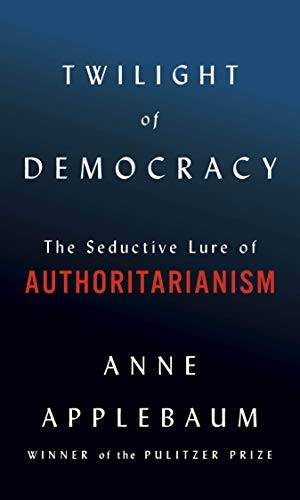
Twilight of Democracy: The Seductive Lure of Authoritarianism by Anne Applebaum is a 2020 history book about authoritarianism, democracy, political psychology. Authoritarian politics appeals most strongly to educated people who feel the meritocratic order has denied them their rightful status — Applebaum calls them the 'clerisy.'
Summary
Anne Applebaum opens Twilight of Democracy with a party she and her husband hosted on New Year's Eve 1999, celebrating the new millennium with a hundred friends and colleagues in Poland. By 2019, when she began writing this book, half of those people were no longer speaking to her — estranged not by personal quarrels but by politics. Many had moved toward authoritarian nationalist parties in Poland, Hungary, the United Kingdom, and the United States. The book is an attempt to understand how that happened.
Applebaum's central argument is that authoritarian movements attract a particular psychological type she calls the "clerisy" — educated, ambitious people who feel that meritocracy has failed to give them the status they deserve, and who find in nationalist-authoritarian politics a new hierarchy in which loyalty to the leader is rewarded regardless of talent. She identifies this pattern across Europe and America, tracing it through specific individuals she has known: journalists who became propagandists, intellectuals who found late meaning in nostalgia, politicians who discovered that conspiracy theories moved voters more reliably than policy.
The book is partly a work of political analysis and partly a personal essay. Applebaum reflects on the breakdown of her own friendships and the ideological evolution of people she once regarded as principled conservatives. She argues that the nostalgia driving much authoritarian politics is not for a real past but for an imagined one — one in which the clerisy occupied its rightful place and the disruptions of pluralism, immigration, and cultural change had not yet arrived. Authoritarian leaders, she argues, are skilled at channeling that nostalgia into political energy.
At roughly 180 pages, this is a lean and relatively focused book. Applebaum is not attempting a comprehensive theory; she's tracing a specific social and psychological dynamic through people she knows. The analysis is most persuasive when applied to the European cases she knows best — Poland and Hungary especially. Its application to American politics is less granular but follows similar lines. The honest admission that she is writing about friends and former friends gives the book an unusual texture: it is not a detached diagnosis but a reckoning.
Talk to Twilight of Democracy: The Seductive Lure of Authoritarianism like its author wrote you back.
Get the ideas that fit your life — not generic summaries.
- Chat with the book
- Audiobook-style main ideas
- Adapts to your life and goals
- Helps you take action
Key takeaways
- 1.
Authoritarian politics appeals most strongly to educated people who feel the meritocratic order has denied them their rightful status — Applebaum calls them the 'clerisy.'
- 2.
Nostalgia for an imagined past, not a real one, is the emotional engine of modern authoritarian movements. The longing is for hierarchy and certainty, not any specific policy.
- 3.
Loyalty to the leader is valued over competence in authoritarian systems, which means they systematically reward second-rate thinkers willing to flatten their arguments.
- 4.
Propaganda in authoritarian-adjacent democracies operates differently from Soviet propaganda: its goal is not to convince but to confuse, to make facts feel unreliable.
- 5.
The breakdown of old friendships along political lines reflects a deeper change: political identity has come to substitute for other forms of social belonging.
- 6.
Hungary under Viktor Orbán is Applebaum's clearest case study: a functioning democracy dismantled incrementally through legal mechanisms, not a coup.
- 7.
Intellectuals who move toward authoritarianism typically do so for personal as much as ideological reasons — resentment, status anxiety, and the appeal of being on a winning side.
- 8.
Democracies require their citizens to tolerate ambiguity and accept outcomes they dislike. Authoritarianism promises clarity and belonging, which are psychologically potent.
Discussion questions
Use these on your own, with a book club, or as chat starters in Superbook. Book club version, ready to copy or print →
- 1.
Applebaum describes a party in 1999 where half the guests later became political opponents. Can you map a similar fracture in your own social circle?
- 2.
Her concept of the 'clerisy' — educated people drawn to authoritarianism by status anxiety — does it describe anyone in your political environment convincingly?
- 3.
She argues that authoritarian nostalgia is for an imagined past, not a real one. What specifically is being imagined, and who gets to imagine it?
- 4.
Applebaum focuses on Poland, Hungary, and Britain. How well does her framework translate to the political context you live in?
- 5.
Is the proposition that authoritarian movements attract second-rate intellectuals too snobbish, or does the evidence support it?
- 6.
She says modern propaganda aims not to convince but to confuse. What does that imply for how journalists and institutions should respond to it?
- 7.
The book argues that the willingness to dismantle democratic norms often comes from within: lawyers, judges, legislators. Does that shift how you think about democratic resilience?
- 8.
Applebaum writes about friends who changed. Is personal estrangement over politics a symptom or a cause of democratic erosion?
- 9.
How much of the authoritarian appeal she describes is permanent, and how much is contingent on specific economic or cultural conditions that could change?
- 10.
The book is quite short for its subject. Did its brevity feel like a virtue — focused, essayistic — or did it leave important questions unanswered?
- 11.
Applebaum ends without a strong prescription for reversing the trend she describes. Is that honest or evasive?
- 12.
Which European case — Poland, Hungary, or Britain — struck you as the most instructive parallel to democratic politics elsewhere?
Themes
Frequently asked questions
-
Is Twilight of Democracy worth reading?
Yes, especially if you want a short, personal account of why educated people are drawn to authoritarian movements. It is more essay than treatise — Applebaum is working through something she has witnessed firsthand — and that gives it an honesty that more academic treatments lack.
-
How long does it take to read Twilight of Democracy?
About four hours at average reading pace. The book is around 180 pages and reads quickly. It can be finished in a single sitting or over two or three evenings.
-
What is the book's main argument?
That authoritarian movements in democracies are sustained less by mass enthusiasm than by a small intellectual class that provides legitimacy in exchange for status. These are people who feel overlooked by meritocratic institutions and who find in nationalist politics a new hierarchy that rewards loyalty over competence.
-
How does this book relate to Applebaum's other work?
Gulag and Iron Curtain deal with Soviet totalitarianism as a historical phenomenon. Twilight of Democracy is about the contemporary resurgence of authoritarian politics in democracies that lived through that history. The two bodies of work reinforce each other.
-
Who is this book for?
Anyone trying to understand why democracies erode from within rather than through dramatic coups, and why educated people often facilitate the erosion. It is particularly relevant for readers watching democratic backsliding in their own countries.
Similar books

Sapiens: A Brief History of Humankind
Yuval Noah Harari

The Rise and Fall of the Third Reich
William L. Shirer

Enlightenment Now
Steven Pinker

The Better Angels of Our Nature
Steven Pinker
