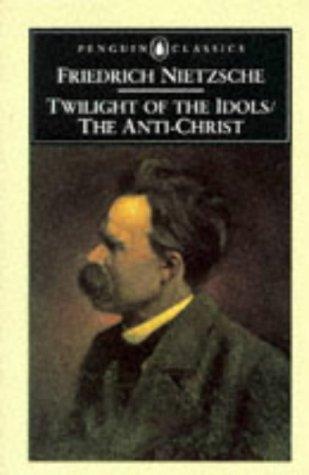
Talk to Twilight of the Idols like its author wrote you back.
Get the ideas that fit your life — not generic summaries.
- Chat with the book
- Audiobook-style main ideas
- Adapts to your life and goals
- Helps you take action
Twilight of the Idols, in detail
Twilight of the Idols, written by Nietzsche in just a few weeks in 1888 and published the following year, is one of his most concentrated and accessible works. The title parodies Wagner's Twilight of the Gods (Götterdämmerung) and announces the project: the systematic demolition of philosophical, moral, and cultural illusions that Nietzsche regarded as life-denying evasions. The subtitle — How to Philosophize with a Hammer — describes the method: each section strikes at a foundational assumption of Western thought.
The most important section for understanding Nietzsche's mature philosophy is "How the 'True World' Finally Became a Fable," a compressed six-stage history of how the Platonic distinction between the apparent world and the true world emerged, peaked, became unbelievable, and finally — with Nietzsche — collapsed entirely. This section is the clearest statement of Nietzsche's position that the metaphysical world invented as a corrective to sensory experience is itself an error, and that the consequences of this error have saturated Western morality.
The sections attacking Socrates, Plato, and Kant are combative and deliberately unfair in places, but they identify real tensions: Nietzsche's case that Socratic rationalism is itself a symptom of cultural decline rather than a remedy for it, and that Kant's noumenal world is the Platonic True World in disguise. The sections on morality argue that Christian ethics and its secular descendants are not universal truths but expressions of a particular type of psychology — specifically the psychology of weakness claiming to be virtue.
The final sections — on the Germans, on art, and the extended meditation on what he calls his "Morality for Psychologists" — are more personal. Nietzsche's admiration for Goethe as the model of a value-creating individual, and his contrast of Goethe with Rousseau, is one of the clearest expressions of his positive vision. The book is a better introduction to late Nietzsche than Beyond Good and Evil for readers who want a compressed, readable entry point to his core critique without the aphoristic fragmentation of his earlier style.
The big ideas
- 1.
The 'true world' of Platonic metaphysics — the realm behind appearances — is not a discovery but an invention, and its collapse leaves not nothing but a world fully available to experience.
- 2.
Socratism is not the opposite of decadence but one of its symptoms: when a culture loses confidence in instinct, it over-invests in reason as a compensatory mechanism.
- 3.
Nietzsche's target is not morality as such but morality that presents life-denial as virtue — that treats suffering, restraint, and weakness as intrinsically good rather than contingently useful.
