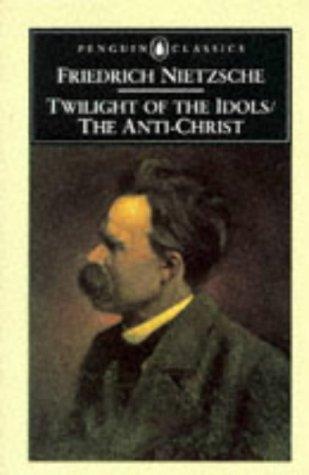
Twilight of the Idols by Friedrich Nietzsche is a 1889 philosophy book about nihilism, morality, culture. The 'true world' of Platonic metaphysics — the realm behind appearances — is not a discovery but an invention, and its collapse leaves not nothing but a world fully available to experience.
Summary
Twilight of the Idols, written by Nietzsche in just a few weeks in 1888 and published the following year, is one of his most concentrated and accessible works. The title parodies Wagner's Twilight of the Gods (Götterdämmerung) and announces the project: the systematic demolition of philosophical, moral, and cultural illusions that Nietzsche regarded as life-denying evasions. The subtitle — How to Philosophize with a Hammer — describes the method: each section strikes at a foundational assumption of Western thought.
The most important section for understanding Nietzsche's mature philosophy is "How the 'True World' Finally Became a Fable," a compressed six-stage history of how the Platonic distinction between the apparent world and the true world emerged, peaked, became unbelievable, and finally — with Nietzsche — collapsed entirely. This section is the clearest statement of Nietzsche's position that the metaphysical world invented as a corrective to sensory experience is itself an error, and that the consequences of this error have saturated Western morality.
The sections attacking Socrates, Plato, and Kant are combative and deliberately unfair in places, but they identify real tensions: Nietzsche's case that Socratic rationalism is itself a symptom of cultural decline rather than a remedy for it, and that Kant's noumenal world is the Platonic True World in disguise. The sections on morality argue that Christian ethics and its secular descendants are not universal truths but expressions of a particular type of psychology — specifically the psychology of weakness claiming to be virtue.
The final sections — on the Germans, on art, and the extended meditation on what he calls his "Morality for Psychologists" — are more personal. Nietzsche's admiration for Goethe as the model of a value-creating individual, and his contrast of Goethe with Rousseau, is one of the clearest expressions of his positive vision. The book is a better introduction to late Nietzsche than Beyond Good and Evil for readers who want a compressed, readable entry point to his core critique without the aphoristic fragmentation of his earlier style.
Talk to Twilight of the Idols like its author wrote you back.
Get the ideas that fit your life — not generic summaries.
- Chat with the book
- Audiobook-style main ideas
- Adapts to your life and goals
- Helps you take action
Key takeaways
- 1.
The 'true world' of Platonic metaphysics — the realm behind appearances — is not a discovery but an invention, and its collapse leaves not nothing but a world fully available to experience.
- 2.
Socratism is not the opposite of decadence but one of its symptoms: when a culture loses confidence in instinct, it over-invests in reason as a compensatory mechanism.
- 3.
Nietzsche's target is not morality as such but morality that presents life-denial as virtue — that treats suffering, restraint, and weakness as intrinsically good rather than contingently useful.
- 4.
The will to power, as Nietzsche uses it here, is not domination of others but the drive toward self-overcoming, the expansion of one's capacities, which he regards as the fundamental drive in all living things.
- 5.
German philosophy from Kant onward is diagnosed as a continuation of Christian metaphysics in secular terms — the noumenal remains the true world, even when God is removed from the argument.
- 6.
Goethe represents Nietzsche's positive ideal: someone who disciplines rather than denies desire, who affirms life in its totality including suffering, and who is productive rather than merely critical.
- 7.
The abolition of the true world abolishes the apparent world too: once the contrast disappears, what remains is simply the world — fully real, fully available, without the denigration of either.
Discussion questions
Use these on your own, with a book club, or as chat starters in Superbook. Book club version, ready to copy or print →
- 1.
Nietzsche argues that the distinction between appearance and reality, as developed from Plato onward, is the foundational error of Western thought. Do you find that argument convincing, or is some version of that distinction necessary?
- 2.
His diagnosis of Socrates as symptomatic of cultural decline is deliberately provocative. What evidence could count for or against the claim that reason becomes dominant when instinct fails, rather than when instinct thrives?
- 3.
Nietzsche often writes as though he is diagnosing cultural illness in others. Is there a tension between that diagnostic stance and his own philosophical project? Can a nihilism-demolisher avoid being infected by the nihilism he diagnoses?
- 4.
The Goethe portrait in the book is Nietzsche's model of the affirmative type. Does that portrait match what you know of Goethe, and is it an inspiring model or a convenient fiction?
- 5.
He says he philosophizes with a hammer — testing idols to see whether they ring hollow. Which of the idols he strikes seems most hollow to you today? Which still rings solid?
- 6.
The morality of weakness claiming to be virtue is Nietzsche's characterization of Christian ethics and its descendants. Where in contemporary culture do you see that pattern most clearly?
- 7.
Nietzsche's critique of German culture in 1888 is specific to Wilhelmine Germany. How much of it is historical curiosity and how much transfers to contemporary conditions?
- 8.
He argues that the apparent world and the true world must both be abolished — what survives is just the world. What does that mean for ethics, for epistemology, and for how you actually live?
- 9.
The title parodies Wagner, whom Nietzsche had once admired and later broke with. The intellectual break with a former hero is a recurring Nietzsche theme. What does it reveal about how he thought philosophical development worked?
- 10.
Twilight of the Idols is both a demolition and a hint of an affirmative philosophy. Do you find the affirmative parts convincing, or does Nietzsche work better as a critic than as a builder?
- 11.
His writing style here — aphoristic, combative, compressed — is part of the argument about how philosophy should be done. Does the style enhance or undermine the content for you?
Themes
Frequently asked questions
-
Is Twilight of the Idols a good entry point for Nietzsche?
Yes — it is one of his most compressed and readable works, written late when his ideas were fully developed, and it covers most of his key themes. Beyond Good and Evil and The Genealogy of Morality go deeper, but Twilight gives you the essential critique in a few hours.
-
How long does it take to read Twilight of the Idols?
About two hours for the text itself, though the density of the argument rewards slower reading with pauses. Many readers take four to six hours if they work through the sections carefully rather than reading quickly.
-
What is the main argument of Twilight of the Idols?
That Western philosophy and morality have been built on the invented distinction between an apparent world and a 'true' world behind it — and that demolishing this distinction does not lead to nihilism but to a full engagement with the world as it actually is.
-
Is Nietzsche's philosophy dangerous?
His work has been misappropriated by ideologies he would have despised. Read in context, his critique targets the life-denying, not the life-affirming; it attacks the pretension to universal values, not ethics as such. The danger is in partial or decontextualized reading.
-
What's the most useful idea in the book for a contemporary reader?
The question about which of our moral and cultural assumptions are genuine conclusions and which are inherited evasions. Applied honestly, it is a productive tool for examining received ideas — about success, virtue, and what constitutes a good life.