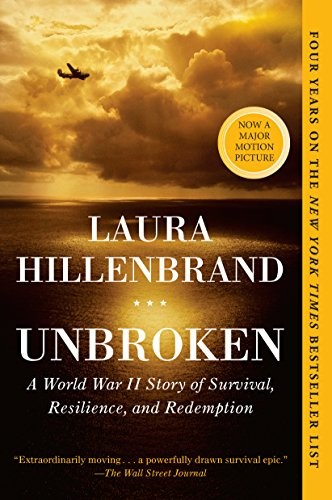
Talk to Unbroken: A World War II Story of Survival, Resilience, and Redemption like its author wrote you back.
Get the ideas that fit your life — not generic summaries.
- Chat with the book
- Audiobook-style main ideas
- Adapts to your life and goals
- Helps you take action
Unbroken: A World War II Story of Survival, Resilience, and Redemption, in detail
Unbroken follows Louis Zamperini from his juvenile delinquency in Depression-era California to the 1936 Berlin Olympics, where he ran the 5,000 meters at nineteen and briefly caught Hitler's attention. Hillenbrand builds this early section carefully: she wants the reader to understand who Zamperini was before catastrophe stripped everything away. He was fast, stubborn, adaptable, and unusually good at enduring discomfort — qualities that would later keep him alive.
In 1943 his B-24 crashed into the Pacific. Of eleven men aboard, three survived the impact. Zamperini and two crewmates drifted on a life raft for forty-seven days, the longest known survival at sea by Allied airmen in World War II. They caught fish with their bare hands, fought off sharks, survived strafing by Japanese aircraft, and watched one of the three men die. Hillenbrand renders the arithmetic of starvation and the psychology of hope with documentary precision. When the survivors were finally found, it was by the Japanese Navy.
The POW sections are the hardest to read. Zamperini passed through several camps, but the central ordeal was his time at Omori and Naoetsu under Mutsuhiro Watanabe, a guard known to prisoners as "the Bird." Watanabe's campaign against Zamperini was personal and relentless — a former Olympian was a useful symbol to break. The beatings were frequent, the humiliations calculated. Hillenbrand interviewed dozens of survivors and worked from diaries, letters, and military records to reconstruct what captivity felt like from the inside, not just what happened. The result is less a catalogue of atrocities than a study in how the mind negotiates with unbearable circumstances.
After the war Zamperini returned to severe post-traumatic stress, alcoholism, and a disintegrating marriage. His recovery came through a Billy Graham revival meeting in 1949. Hillenbrand treats the religious conversion with neither skepticism nor endorsement — she reports what Zamperini said he experienced and what changed afterward. He eventually confronted his captors, including an attempt to meet Watanabe in person that was never completed. He died in 2014 at ninety-seven. The book's power is inseparable from Hillenbrand's craft: she wrote most of it while largely confined to her home by chronic fatigue syndrome, conducting research by phone and mail. The physical effort the book required of its subject and its author is part of the same story.
The big ideas
- 1.
The human capacity for endurance is greater than most people believe. Zamperini survived forty-seven days at sea on almost nothing, largely through mental discipline and refusal to accept death as inevitable.
- 2.
Deliberate cruelty against a specific person can destroy them even when physical deprivation alone would not. Watanabe's targeting of Zamperini was as psychological as it was physical.
- 3.
Identity provides an anchor in extreme conditions. Zamperini repeatedly returned to the fact of what he had been — an Olympian — as evidence that he could survive what he was facing.
