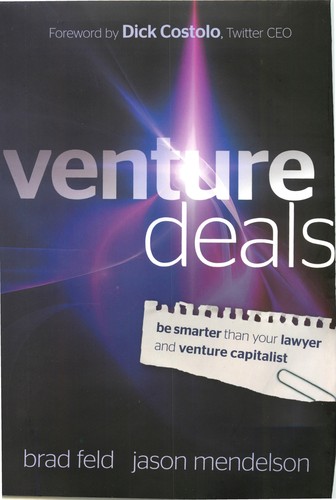
Talk to Venture Deals: Be Smarter Than Your Lawyer and Venture Capitalist like its author wrote you back.
Get the ideas that fit your life — not generic summaries.
- Chat with the book
- Audiobook-style main ideas
- Adapts to your life and goals
- Helps you take action
Venture Deals: Be Smarter Than Your Lawyer and Venture Capitalist, in detail
Venture Deals is Brad Feld and Jason Mendelson's guide to understanding venture capital term sheets — the documents that define the economic and control terms of startup funding. Both are general partners at Foundry Group; Mendelson spent years as a lawyer before becoming a venture capitalist. The book was written explicitly to reduce the information asymmetry that typically benefits VCs and legal advisors at the expense of founders who are negotiating their first or second funding round without adequate context.
The book walks through the two main categories of term sheet provisions: economic terms and control terms. Economic terms include the pre-money valuation, investment amount, option pool size, liquidation preferences, and anti-dilution provisions. Control terms include board composition, voting rights, protective provisions, and drag-along rights. Each provision is explained in plain language with worked examples showing how it affects founders in both good and bad outcomes.
Feld and Mendelson are explicit about which terms matter most and which are largely negotiating theater. The most important economic terms are valuation, option pool sizing (because it affects the effective pre-money valuation), and liquidation preference structure. The most important control terms are board composition and drag-along rights. Other provisions — like reverse vesting acceleration — are worth understanding but rarely determine outcomes.
The book has been updated multiple times since its first edition and is widely considered the standard reference for founders navigating VC financing. The honest caveat: specific market norms change, and some practices described as standard have shifted with market conditions. The third edition (2019) is the most current. For founders raising angel or seed rounds, Y Combinator's SAFE and Stripe's standard documents have simplified the process significantly, but Venture Deals remains essential for understanding Series A and beyond.
The big ideas
- 1.
Term sheets have two categories of provisions: economic terms (how the money is divided) and control terms (who makes decisions). Understanding both is essential before signing anything.
- 2.
Liquidation preferences determine who gets paid first and how much in an exit. A 2x participating preferred is dramatically different from a 1x non-participating preferred in most outcome scenarios.
- 3.
The option pool shuffle: VCs often require a large option pool to be created before the investment closes, which dilutes existing shareholders rather than new investors. The pre-money valuation must be evaluated after accounting for this.
