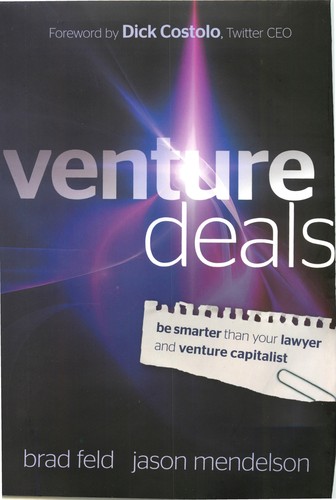
Venture Deals: Be Smarter Than Your Lawyer and Venture Capitalist by Brad Feld and Jason Mendelson is a 2011 business book about venture capital, startups, finance. Term sheets have two categories of provisions: economic terms (how the money is divided) and control terms (who makes decisions). Understanding both is essential before signing anything.
Summary
Venture Deals is Brad Feld and Jason Mendelson's guide to understanding venture capital term sheets — the documents that define the economic and control terms of startup funding. Both are general partners at Foundry Group; Mendelson spent years as a lawyer before becoming a venture capitalist. The book was written explicitly to reduce the information asymmetry that typically benefits VCs and legal advisors at the expense of founders who are negotiating their first or second funding round without adequate context.
The book walks through the two main categories of term sheet provisions: economic terms and control terms. Economic terms include the pre-money valuation, investment amount, option pool size, liquidation preferences, and anti-dilution provisions. Control terms include board composition, voting rights, protective provisions, and drag-along rights. Each provision is explained in plain language with worked examples showing how it affects founders in both good and bad outcomes.
Feld and Mendelson are explicit about which terms matter most and which are largely negotiating theater. The most important economic terms are valuation, option pool sizing (because it affects the effective pre-money valuation), and liquidation preference structure. The most important control terms are board composition and drag-along rights. Other provisions — like reverse vesting acceleration — are worth understanding but rarely determine outcomes.
The book has been updated multiple times since its first edition and is widely considered the standard reference for founders navigating VC financing. The honest caveat: specific market norms change, and some practices described as standard have shifted with market conditions. The third edition (2019) is the most current. For founders raising angel or seed rounds, Y Combinator's SAFE and Stripe's standard documents have simplified the process significantly, but Venture Deals remains essential for understanding Series A and beyond.
Talk to Venture Deals: Be Smarter Than Your Lawyer and Venture Capitalist like its author wrote you back.
Get the ideas that fit your life — not generic summaries.
- Chat with the book
- Audiobook-style main ideas
- Adapts to your life and goals
- Helps you take action
Key takeaways
- 1.
Term sheets have two categories of provisions: economic terms (how the money is divided) and control terms (who makes decisions). Understanding both is essential before signing anything.
- 2.
Liquidation preferences determine who gets paid first and how much in an exit. A 2x participating preferred is dramatically different from a 1x non-participating preferred in most outcome scenarios.
- 3.
The option pool shuffle: VCs often require a large option pool to be created before the investment closes, which dilutes existing shareholders rather than new investors. The pre-money valuation must be evaluated after accounting for this.
- 4.
Board composition is one of the most important control provisions. A board controlled by investors can remove founders, block strategy changes, and force an early exit against the founders' wishes.
- 5.
Anti-dilution protection adjusts an investor's ownership percentage if the company raises a down round. Full-ratchet anti-dilution is very investor-friendly; weighted-average is more balanced.
- 6.
Protective provisions give investors veto rights over specific actions — taking on debt, selling the company, creating new share classes. Understanding which actions require investor consent matters as the company scales.
- 7.
Most legal fees in VC transactions are paid by the startup. Knowing what is reasonable versus excessive helps founders control transaction costs.
- 8.
The relationship with your VC matters more than most specific term sheet provisions. A fair deal with a bad partner is worse than a slightly less favorable deal with a great one.
Discussion questions
Use these on your own, with a book club, or as chat starters in Superbook. Book club version, ready to copy or print →
- 1.
Feld and Mendelson argue that most founders don't understand the term sheets they sign. What are the consequences of that information asymmetry, and who bears the cost of it?
- 2.
The option pool shuffle effectively reduces the pre-money valuation from the founder's perspective. Is that a problem with the practice itself or with how it is communicated?
- 3.
What factors beyond valuation should a founder use to evaluate a VC offer? How do you weight them?
- 4.
Board composition is described as the most important control term. When would a founder-controlled board be better for a company, and when would an investor-controlled or balanced board be?
- 5.
How has the rise of SAFEs and YC-standard documents for seed rounds changed the dynamics Venture Deals describes? What problems have they solved and what have they not addressed?
- 6.
Feld and Mendelson say the relationship with the VC matters more than most specific deal terms. How do you evaluate that relationship quality before closing a deal?
- 7.
Anti-dilution provisions protect investors in down rounds. What should a founder know about their anti-dilution terms before hitting a difficult fundraising environment?
- 8.
What is the difference between a participating and non-participating liquidation preference, and in what outcome scenarios does the difference matter most?
- 9.
The book argues that most deal economics are within a relatively narrow market range. If that's true, why do negotiations over economic terms consume so much time and emotional energy?
- 10.
How does the structure of a VC fund — its vintage, size, and stage focus — affect the advice your investors will give you and the decisions they'll push you toward?
- 11.
Venture Deals focuses on US VC conventions. How much do terms and norms vary in other startup ecosystems — Europe, Southeast Asia, Latin America?
Themes
Frequently asked questions
-
Is Venture Deals worth reading for founders who are not yet raising VC?
Yes. Understanding VC economics before you need to negotiate changes how you structure your company, how you talk to investors, and what trade-offs you make in early decisions. Reading it prospectively is more valuable than reading it under deadline pressure.
-
What edition of Venture Deals should I read?
The third edition (2019) is the most current. The first edition is from 2011 and some market conventions have shifted. The core frameworks are stable across editions, but the third adds updates on SAFEs, convertible notes, and post-money valuations.
-
What is a liquidation preference?
A provision that gives investors the right to receive a specific multiple of their investment before common shareholders receive anything in a sale or liquidation. A 1x non-participating preferred means investors get their money back first, then share in remaining proceeds. Participating preferred means investors take their multiple plus a proportional share of remaining proceeds.
-
What is the option pool shuffle?
A practice where VCs require a large option pool to be created before the investment closes, using shares from existing shareholders rather than the new investment. Because the pool creation happens before the VC's shares are issued, it effectively dilutes founders and existing investors rather than the incoming VC.
-
How does Venture Deals relate to SAFEs and convertible notes?
SAFEs and convertible notes are simpler instruments often used for seed rounds to defer the complex term sheet negotiation. Venture Deals covers these briefly but focuses on priced equity rounds, which are standard for Series A and beyond. Understanding Venture Deals is still valuable even if your early rounds used SAFEs.
Similar books
Zero to One: Notes on Startups, or How to Build the Future
Peter Thiel

Blitzscaling: The Lightning-Fast Path to Building Massively Valuable Companies
Reid Hoffman and Chris Yeh
The Hard Thing About Hard Things
Ben Horowitz

Rework
Jason Fried and David Heinemeier Hansson
