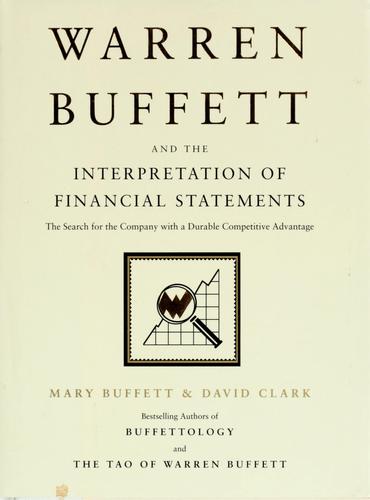
Talk to Warren Buffett and the Interpretation of Financial Statements like its author wrote you back.
Get the ideas that fit your life — not generic summaries.
- Chat with the book
- Audiobook-style main ideas
- Adapts to your life and goals
- Helps you take action
Warren Buffett and the Interpretation of Financial Statements, in detail
Warren Buffett and the Interpretation of Financial Statements is Mary Buffett's guide to reading the three core financial statements — income statement, balance sheet, and cash flow statement — through the lens Warren Buffett uses when evaluating companies. The central thesis is that Buffett isn't looking at earnings per se; he's looking for evidence of a durable competitive advantage. Companies with real moats show their moat in the numbers, and once you know what to look for, the signals are consistent.
The book is organized around each statement in turn. On the income statement, high and consistent gross margins signal pricing power. Low research and development expenses, combined with minimal selling and administrative costs, indicate a business that doesn't have to spend heavily to stay competitive. On the balance sheet, low or zero long-term debt is a hallmark of durable competitive advantage. Companies that need a lot of long-term debt to operate are generally fighting uphill battles. Strong retained earnings, growing year over year, indicate management that reinvests efficiently.
The cash flow statement gets less space but is treated as the final verification: free cash flow is what actually determines whether a company can grow without diluting shareholders, pay down debt, or buy back stock. Buffett's preference for capital-light businesses shows up clearly in capex as a percentage of net earnings — the lower, the better.
What makes the book useful is the specificity. Buffett's thinking has been discussed at length, but Mary Buffett's contribution is translating abstract concepts about moats into concrete ratios and line items. The book is short by design, which means the breadth of topics is limited. It doesn't cover valuation deeply, it sidesteps macroeconomic context, and it assumes a relatively stable business environment. Read alongside something on valuation and it becomes a more complete toolkit. On its own, it's the clearest short treatment of what Buffett actually sees when he reads a 10-K.
The big ideas
- 1.
Consistent gross margins above 40% are a strong signal of durable competitive advantage. Erratic or thin margins suggest intense competition.
- 2.
Low selling, general, and administrative expenses as a percentage of gross profit indicate a business that sells itself rather than relying on expensive marketing.
- 3.
Buffett avoids companies with heavy research and development needs. Heavy R&D is a sign that the competitive advantage isn't durable.
