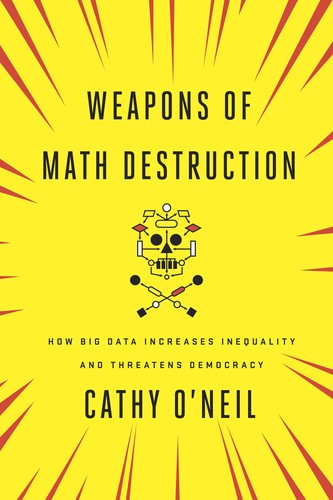
Talk to Weapons of Math Destruction like its author wrote you back.
Get the ideas that fit your life — not generic summaries.
- Chat with the book
- Audiobook-style main ideas
- Adapts to your life and goals
- Helps you take action
Weapons of Math Destruction, in detail
Weapons of Math Destruction is mathematician and data scientist Cathy O'Neil's investigation of how algorithms — statistical models used to make decisions about people's lives — can perpetuate and amplify inequality rather than reduce it. O'Neil coined the phrase "weapon of math destruction" (WMD) to describe a class of models that are opaque, widely applied, and self-reinforcing, operating on vulnerable populations and producing feedback loops that make outcomes worse for those already disadvantaged.
The examples span multiple sectors. Teacher evaluation algorithms in public schools produced ratings that varied dramatically year to year for the same teachers, reflecting noise rather than quality. Predictive policing algorithms trained on historical arrest data — which reflects racially biased prior policing — direct more police to minority neighborhoods, producing more arrests, which confirms the model's prediction, which directs more police, in a self-reinforcing cycle. Credit scoring algorithms built on zip code and purchasing behavior effectively penalize people for living in poor neighborhoods. College ranking algorithms by US News & World Report have driven universities to optimize for metrics rather than educational outcomes.
O'Neil's definition of a WMD has three elements: it is opaque (subjects can't understand why decisions were made), it scales to large populations (it applies the same model to millions of people), and it is damaging (the errors or biases in the model harm the people it scores). She argues these features combine to create a form of algorithmic injustice that is both harder to see than human discrimination and harder to challenge because it carries the apparent authority of mathematics.
The book is accessible and engagingly written. O'Neil herself worked at a hedge fund and then in the data science industry before becoming an activist critic of how data is deployed. That combination of insider knowledge and critical perspective gives the book an authority that distinguishes it from both pure activism and pure technical critique.
The big ideas
- 1.
Algorithms are not neutral: they encode the values and biases of the people who design them, and they can perpetuate discrimination more efficiently and at greater scale than individual human decision-makers.
- 2.
A weapon of math destruction has three properties: opacity (subjects can't understand the decision), scale (it applies to millions), and damage (errors harm the people scored).
- 3.
Feedback loops in predictive algorithms can be self-reinforcing: a model trained on biased historical data produces outputs that generate new data that confirms the bias, compounding its effects over time.
