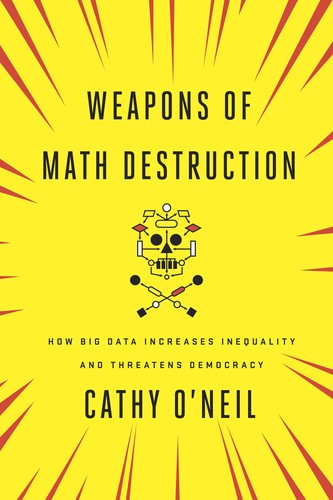
Weapons of Math Destruction by Cathy O'Neil is a 2016 science book about algorithms, inequality, data science. Algorithms are not neutral: they encode the values and biases of the people who design them, and they can perpetuate discrimination more efficiently and at greater scale than individual human decision-makers.
Summary
Weapons of Math Destruction is mathematician and data scientist Cathy O'Neil's investigation of how algorithms — statistical models used to make decisions about people's lives — can perpetuate and amplify inequality rather than reduce it. O'Neil coined the phrase "weapon of math destruction" (WMD) to describe a class of models that are opaque, widely applied, and self-reinforcing, operating on vulnerable populations and producing feedback loops that make outcomes worse for those already disadvantaged.
The examples span multiple sectors. Teacher evaluation algorithms in public schools produced ratings that varied dramatically year to year for the same teachers, reflecting noise rather than quality. Predictive policing algorithms trained on historical arrest data — which reflects racially biased prior policing — direct more police to minority neighborhoods, producing more arrests, which confirms the model's prediction, which directs more police, in a self-reinforcing cycle. Credit scoring algorithms built on zip code and purchasing behavior effectively penalize people for living in poor neighborhoods. College ranking algorithms by US News & World Report have driven universities to optimize for metrics rather than educational outcomes.
O'Neil's definition of a WMD has three elements: it is opaque (subjects can't understand why decisions were made), it scales to large populations (it applies the same model to millions of people), and it is damaging (the errors or biases in the model harm the people it scores). She argues these features combine to create a form of algorithmic injustice that is both harder to see than human discrimination and harder to challenge because it carries the apparent authority of mathematics.
The book is accessible and engagingly written. O'Neil herself worked at a hedge fund and then in the data science industry before becoming an activist critic of how data is deployed. That combination of insider knowledge and critical perspective gives the book an authority that distinguishes it from both pure activism and pure technical critique.
Talk to Weapons of Math Destruction like its author wrote you back.
Get the ideas that fit your life — not generic summaries.
- Chat with the book
- Audiobook-style main ideas
- Adapts to your life and goals
- Helps you take action
Key takeaways
- 1.
Algorithms are not neutral: they encode the values and biases of the people who design them, and they can perpetuate discrimination more efficiently and at greater scale than individual human decision-makers.
- 2.
A weapon of math destruction has three properties: opacity (subjects can't understand the decision), scale (it applies to millions), and damage (errors harm the people scored).
- 3.
Feedback loops in predictive algorithms can be self-reinforcing: a model trained on biased historical data produces outputs that generate new data that confirms the bias, compounding its effects over time.
- 4.
Predictive policing algorithms trained on arrest records effectively penalize minority communities for historical over-policing rather than predicting actual crime risk.
- 5.
College ranking algorithms have distorted university behavior by incentivizing optimization for ranking metrics rather than educational quality, demonstrating that what gets measured gets managed — often at the expense of what matters.
- 6.
The opacity of algorithmic decisions is itself a form of power: people who cannot understand why they were denied a job, a loan, or bail cannot effectively challenge the decision.
- 7.
Proxy variables — using zip code or purchasing behavior as a stand-in for creditworthiness or risk — often correlate with race, gender, or poverty in ways that effectively discriminate without explicitly doing so.
- 8.
Regulation and transparency requirements for high-stakes algorithmic decision-making — employment, criminal justice, credit — are necessary complements to industry self-governance.
Discussion questions
Use these on your own, with a book club, or as chat starters in Superbook. Book club version, ready to copy or print →
- 1.
O'Neil argues algorithms can be more discriminatory than human decision-makers because they scale faster and are harder to challenge. Does that argument seem right to you?
- 2.
The feedback loop problem — biased data producing biased outputs that generate new biased data — is described in predictive policing. Can you think of other domains where this pattern operates?
- 3.
She defines WMDs by opacity, scale, and damage. Which feature do you think is most essential to the harm she describes?
- 4.
Proxy discrimination — using variables that correlate with protected characteristics without explicitly using those characteristics — is technically legal but practically discriminatory. How should law address it?
- 5.
How much transparency do you think is necessary for an algorithmic decision to be legitimately challengeable by the person affected?
- 6.
US News college rankings have distorted university behavior significantly. What other examples of metric optimization that undermines the underlying goal can you identify?
- 7.
O'Neil came from inside the data science industry. Does that background make her critique more or less credible to you?
- 8.
Should people have a right to know when an algorithm has affected a significant decision about their life, and to challenge it?
- 9.
The book was published in 2016, before large language models became widespread. How does her WMD framework apply to current AI systems like GPT?
- 10.
She distinguishes between models used to allocate scarce benefits among the wealthy — used by investment banks — and models used to allocate scarce resources among the poor. Is that distinction morally significant?
- 11.
What specific regulatory requirements would you propose for algorithms used in high-stakes domains like criminal justice or employment?
- 12.
Do you use any of the algorithmic systems she criticizes — credit scoring, personalized feeds, predictive systems — and has reading the book changed how you think about them?
Themes
Frequently asked questions
-
Is Weapons of Math Destruction a technical book?
No. O'Neil explains all technical concepts accessibly. The book uses no mathematics beyond basic familiarity with the idea of a statistical model. It is written for a general audience, not data scientists.
-
What is a weapon of math destruction?
O'Neil's term for an algorithm that is opaque to those it scores, scales to large populations, and causes damage to the people affected. The examples include teacher evaluation models, credit scoring, predictive policing, and hiring algorithms.
-
Is she arguing that all algorithms are harmful?
No. She distinguishes between algorithms that are transparent, limited in scope, and accountable — like the statistical models used to figure out how to delay spam — and weapons of math destruction, which combine opacity, scale, and damage. The problem is the combination of features, not the use of statistics.
-
Has algorithmic accountability improved since the book was published?
Some. The EU's General Data Protection Regulation, the AI Act, and various state laws have introduced transparency requirements for certain automated decisions. O'Neil would argue these are a start but far from sufficient.
-
Who should read Weapons of Math Destruction?
Anyone making or using algorithmic decisions in high-stakes contexts, and anyone who is subject to them — which is almost everyone. The book is accessible and short enough to be read by people without technical backgrounds who want to understand what is being done to them.
Similar books
The Master Algorithm
Pedro Domingos
Code: The Hidden Language of Computer Hardware and Software
Charles Petzold
Human Compatible: Artificial Intelligence and the Problem of Control
Stuart Russell
The Shallows: What the Internet Is Doing to Our Brains
Nicholas Carr
