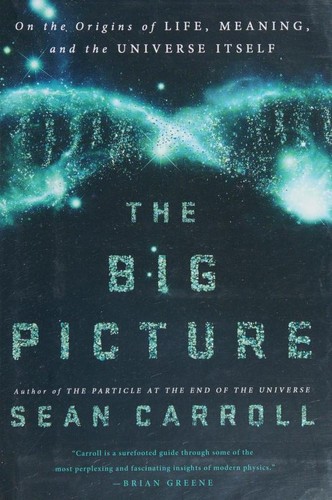
Talk to The Big Picture: On the Origins of Life, Meaning, and the Universe Itself like its author wrote you back.
Get the ideas that fit your life — not generic summaries.
- Chat with the book
- Audiobook-style main ideas
- Adapts to your life and goals
- Helps you take action
The Big Picture: On the Origins of Life, Meaning, and the Universe Itself, in detail
The Big Picture is physicist Sean Carroll's attempt to do something genuinely ambitious: build a coherent worldview from the ground up, starting from the laws of physics and working outward through chemistry, biology, consciousness, and ultimately meaning. Carroll calls his position "poetic naturalism" — the view that the universe is purely physical, contains no supernatural elements, and yet still admits of multiple valid levels of description, including the language of purpose and value that makes human life feel worth living.
The physics section covers quantum mechanics, the arrow of time, and emergence. Carroll argues that the Core Theory — the Standard Model of particle physics combined with general relativity — accurately describes all the physics relevant to everyday life with extraordinary precision. There are no undiscovered forces at human-relevant energy scales that could explain consciousness, free will, or the soul. Whatever minds are, they are made of the same particles as everything else, and their behavior must be compatible with that physics.
The middle sections cover the origin of life, evolution, and consciousness. Carroll is a compatibilist about free will — he thinks determinism and meaningful choice are compatible — and a deflationary but respectful critic of religious explanations. He takes seriously the questions that religion attempts to answer, which makes his critique more interesting than dismissal. The section on Bayesian reasoning and how to update beliefs in the face of evidence is unusually good: Carroll gives the reader tools for thinking about claims rather than just conclusions to accept.
The final third argues that meaning and value are real features of human experience even in a purely physical universe. They are not imposed from outside or discovered in the cosmos; they are constructed by the kinds of creatures we are. Carroll's case for this is careful and earnest. Whether it satisfies will depend on what the reader was looking for — those who want reassurance that meaning exists independently of human minds will find the position cold. Those who find that unnecessary may find it liberating.
The big ideas
- 1.
Poetic naturalism holds that the universe is entirely physical, but that multiple levels of description — from particle physics to human values — are all equally real within their proper domains.
- 2.
The Core Theory (Standard Model plus general relativity) describes all physical phenomena at everyday scales. Any explanation invoking forces beyond it must contend with the fact that no such forces have been detected.
- 3.
The arrow of time — why causes precede effects and why we remember the past but not the future — comes from the low entropy of the Big Bang, not from any fundamental asymmetry in physical law.
