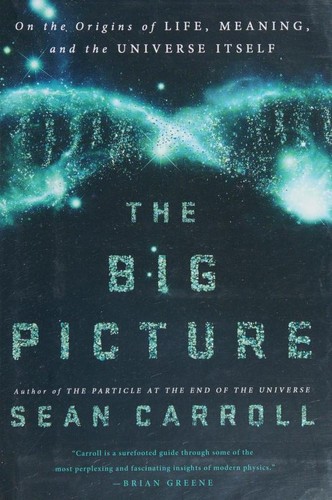
The Big Picture: On the Origins of Life, Meaning, and the Universe Itself by Sean Carroll is a 2016 science book about cosmology, philosophy of science, emergence. Poetic naturalism holds that the universe is entirely physical, but that multiple levels of description — from particle physics to human values — are all equally real within their proper domains.
Summary
The Big Picture is physicist Sean Carroll's attempt to do something genuinely ambitious: build a coherent worldview from the ground up, starting from the laws of physics and working outward through chemistry, biology, consciousness, and ultimately meaning. Carroll calls his position "poetic naturalism" — the view that the universe is purely physical, contains no supernatural elements, and yet still admits of multiple valid levels of description, including the language of purpose and value that makes human life feel worth living.
The physics section covers quantum mechanics, the arrow of time, and emergence. Carroll argues that the Core Theory — the Standard Model of particle physics combined with general relativity — accurately describes all the physics relevant to everyday life with extraordinary precision. There are no undiscovered forces at human-relevant energy scales that could explain consciousness, free will, or the soul. Whatever minds are, they are made of the same particles as everything else, and their behavior must be compatible with that physics.
The middle sections cover the origin of life, evolution, and consciousness. Carroll is a compatibilist about free will — he thinks determinism and meaningful choice are compatible — and a deflationary but respectful critic of religious explanations. He takes seriously the questions that religion attempts to answer, which makes his critique more interesting than dismissal. The section on Bayesian reasoning and how to update beliefs in the face of evidence is unusually good: Carroll gives the reader tools for thinking about claims rather than just conclusions to accept.
The final third argues that meaning and value are real features of human experience even in a purely physical universe. They are not imposed from outside or discovered in the cosmos; they are constructed by the kinds of creatures we are. Carroll's case for this is careful and earnest. Whether it satisfies will depend on what the reader was looking for — those who want reassurance that meaning exists independently of human minds will find the position cold. Those who find that unnecessary may find it liberating.
Talk to The Big Picture: On the Origins of Life, Meaning, and the Universe Itself like its author wrote you back.
Get the ideas that fit your life — not generic summaries.
- Chat with the book
- Audiobook-style main ideas
- Adapts to your life and goals
- Helps you take action
Key takeaways
- 1.
Poetic naturalism holds that the universe is entirely physical, but that multiple levels of description — from particle physics to human values — are all equally real within their proper domains.
- 2.
The Core Theory (Standard Model plus general relativity) describes all physical phenomena at everyday scales. Any explanation invoking forces beyond it must contend with the fact that no such forces have been detected.
- 3.
The arrow of time — why causes precede effects and why we remember the past but not the future — comes from the low entropy of the Big Bang, not from any fundamental asymmetry in physical law.
- 4.
Emergent phenomena are not less real for being reducible in principle. Temperature, life, and consciousness are all emergent, and they are genuinely explanatory at their own level.
- 5.
Bayesian reasoning provides a framework for updating beliefs based on evidence. Starting with honest prior probabilities and updating on evidence produces better-calibrated beliefs than intuition alone.
- 6.
Compatibilism says free will and determinism are not in conflict: what matters is whether our choices are caused by our own reasoning and desires, not whether those are themselves causally determined.
- 7.
The origin of life is an unsolved scientific problem, but Carroll argues that life emerging from chemistry is far more plausible than a designed origin, given what we know about chemistry and selection.
- 8.
Meaning and morality are not discovered in the cosmos but constructed by beings like us. That does not make them less binding — it makes them genuinely ours.
Discussion questions
Use these on your own, with a book club, or as chat starters in Superbook.
- 1.
Carroll argues that the Core Theory leaves no room for undiscovered forces at human-relevant scales. Does that feel like a constraint on explanation, or a clarifying boundary?
- 2.
Poetic naturalism says multiple levels of description are valid simultaneously. Can you think of a case where you switch between levels — say, talking about emotions versus talking about neuroscience — and what you lose or gain in each?
- 3.
Carroll is careful to take religious explanations seriously before rejecting them. Does that approach seem more honest than dismissal, or does it just soften a conclusion that is the same in the end?
- 4.
Bayesian reasoning requires honest prior probabilities. What's one belief you hold where you've never seriously confronted what your prior probability is? What would it take to shift it?
- 5.
The compatibilist view says your choices are still meaningfully yours even if they are physically determined. Does that distinction matter to you emotionally, or only philosophically?
- 6.
Carroll argues that meaning is constructed, not discovered. Does that satisfy you as an account of why anything matters, or does it seem to leave something out?
- 7.
The arrow of time section suggests that if the universe had started in a higher-entropy state, we would remember the future instead of the past. What does that imply about the relationship between memory and causation?
- 8.
Carroll treats consciousness as an emergent physical phenomenon. At what point — if ever — would evidence for something genuinely non-physical be credible to you?
- 9.
The book argues that moral principles can be justified without reference to God or cosmic order. What is the strongest objection to that position?
- 10.
Carroll recommends updating your beliefs using Bayes' theorem. In practice, which of your held beliefs are most resistant to evidence, and why?
- 11.
The final sections argue that we can live well and find value without any external source of meaning. Do you find that conclusion comforting, or does it require something like courage to accept?
- 12.
What is the most surprising claim in the book — the one that most challenged something you thought you understood?
Themes
Frequently asked questions
-
What is The Big Picture about?
It's Carroll's attempt to build a coherent worldview from physics outward, covering the nature of space and time, the origin of life, consciousness, free will, and meaning. The central argument is that a purely physical universe can still accommodate everything that makes human life feel significant.
-
Is The Big Picture worth reading?
Yes, particularly if you want a physicist's serious engagement with philosophy rather than a dismissal of it. Carroll thinks carefully about consciousness, free will, and morality. Readers who want straightforward science exposition may find the philosophical sections slow, but the book rewards patience.
-
Do I need a physics background to read this book?
No. Carroll explains the relevant physics from scratch, including the Standard Model, entropy, and quantum mechanics, at a conceptual level. The philosophy sections require no technical background at all.
-
How does The Big Picture compare to Something Deeply Hidden?
Something Deeply Hidden focuses specifically on quantum mechanics and the many-worlds interpretation. The Big Picture is broader, covering physics, biology, consciousness, and ethics. Both are by the same author and share a naturalist perspective, but they address very different questions.
-
Who should read The Big Picture?
Readers who want a rigorous, honest account of what modern physics implies about reality and meaning. It is well-suited to people who find both religious explanations and purely dismissive atheism unsatisfying, and who want a careful alternative that takes all the hard questions seriously.