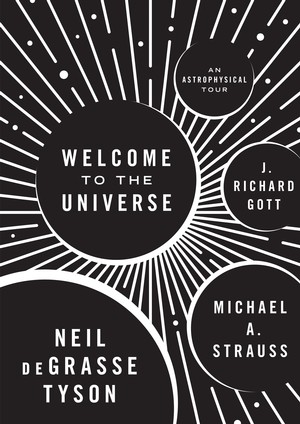
Talk to Welcome to the Universe like its author wrote you back.
Get the ideas that fit your life — not generic summaries.
- Chat with the book
- Audiobook-style main ideas
- Adapts to your life and goals
- Helps you take action
What it argues
Welcome to the Universe began as a popular astrophysics course at Princeton taught by three faculty members — Neil deGrasse Tyson, Michael Strauss, and J. Richard Gott — and the book preserves that classroom structure. Each author handles the topics they know best: Tyson covers stars and galaxies with characteristic showmanship; Strauss explains cosmological observations and the large-scale structure of the universe with a research scientist's precision; Gott ventures into time travel, wormholes, and the topology of the universe with the enthusiasm of someone who has thought about these questions for decades. The combination is unusual and mostly works.
The book proceeds from the familiar to the exotic. Early chapters cover the scale of the universe, the life cycles of stars, and the formation of galaxies — the material a careful reader of popular astronomy has likely encountered before. The treatment here is more quantitative than typical popularizations, which is both a strength and a limitation. Fermi estimation, order-of-magnitude reasoning, and actual equations appear where most popular books wave their hands. Readers comfortable with some mathematics will get more out of it; those who are not can still follow the conceptual thread.
What it gets right
- 1.
The observable universe spans about 93 billion light-years in diameter, contains roughly two trillion galaxies, and has been expanding since the Big Bang 13.8 billion years ago.
- 2.
Stars are not eternal — they have life cycles determined by their mass. Low-mass stars become white dwarfs; massive stars explode as supernovae and leave behind neutron stars or black holes.
- 3.
Black holes form when matter is compressed beyond the Schwarzschild radius. Inside the event horizon, nothing — including light — can escape because the escape velocity exceeds the speed of light.
What it covers
Who wrote it
Neil deGrasse Tyson is an American astrophysicist, director of the Hayden Planetarium in New York, and one of the best-known science communicators in the world. Michael A. Strauss is a professor of astrophysics at Princeton University specializing in quasars and large-scale structure. J. Richard Gott is also a Princeton professor whose research covers general relativity, cosmic strings, and time travel in physics. The three have taught their joint astrophysics course at Princeton for many years; Welcome to the Universe is its written counterpart, published by Princeton University Press.
