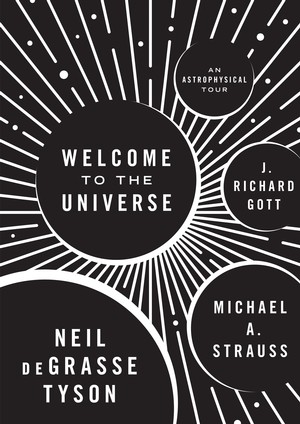
Welcome to the Universe by Neil deGrasse Tyson, Michael A. Strauss, and J. Richard Gott is a 2016 science book about astrophysics, cosmology, space exploration. The observable universe spans about 93 billion light-years in diameter, contains roughly two trillion galaxies, and has been expanding since the Big Bang 13.8 billion years ago.
Summary
Welcome to the Universe began as a popular astrophysics course at Princeton taught by three faculty members — Neil deGrasse Tyson, Michael Strauss, and J. Richard Gott — and the book preserves that classroom structure. Each author handles the topics they know best: Tyson covers stars and galaxies with characteristic showmanship; Strauss explains cosmological observations and the large-scale structure of the universe with a research scientist's precision; Gott ventures into time travel, wormholes, and the topology of the universe with the enthusiasm of someone who has thought about these questions for decades. The combination is unusual and mostly works.
The book proceeds from the familiar to the exotic. Early chapters cover the scale of the universe, the life cycles of stars, and the formation of galaxies — the material a careful reader of popular astronomy has likely encountered before. The treatment here is more quantitative than typical popularizations, which is both a strength and a limitation. Fermi estimation, order-of-magnitude reasoning, and actual equations appear where most popular books wave their hands. Readers comfortable with some mathematics will get more out of it; those who are not can still follow the conceptual thread.
The middle third on black holes, quasars, and relativistic physics is where the book hits its stride. Gott and Strauss are particularly clear on why general relativity is necessary, how event horizons work, and what Hawking radiation implies. The final section on cosmology and multiverse speculation is the most contested, moving from settled science to frontier physics. Gott's chapters on time travel and wormholes are intellectually rigorous but venture into territory where the mathematics is well-developed but the physics remains speculative.
This is not a bedtime read. At nearly 500 pages with equations and detailed diagrams, it asks for focused attention. But for a reader who wants to genuinely understand why physicists believe what they believe about the universe — not just the conclusions but the reasoning — it is one of the more honest and complete introductions available.
Talk to Welcome to the Universe like its author wrote you back.
Get the ideas that fit your life — not generic summaries.
- Chat with the book
- Audiobook-style main ideas
- Adapts to your life and goals
- Helps you take action
Key takeaways
- 1.
The observable universe spans about 93 billion light-years in diameter, contains roughly two trillion galaxies, and has been expanding since the Big Bang 13.8 billion years ago.
- 2.
Stars are not eternal — they have life cycles determined by their mass. Low-mass stars become white dwarfs; massive stars explode as supernovae and leave behind neutron stars or black holes.
- 3.
Black holes form when matter is compressed beyond the Schwarzschild radius. Inside the event horizon, nothing — including light — can escape because the escape velocity exceeds the speed of light.
- 4.
General relativity predicts that space and time are curved by mass and energy. This curvature is responsible for gravity and for the bending of light observed around massive objects.
- 5.
The cosmic microwave background radiation is the oldest electromagnetic signal in the universe, emitted when the universe cooled enough for atoms to form, roughly 380,000 years after the Big Bang.
- 6.
Dark matter and dark energy together constitute about 95% of the total energy content of the universe. Both are inferred from their effects but have not been directly detected.
- 7.
Gott's case for time travel via closed timelike curves is mathematically consistent with general relativity but requires exotic matter with negative energy density — something that may not exist in nature.
- 8.
The multiverse is a legitimate frontier in cosmology, emerging from inflationary models and string theory, but its predictions are difficult or impossible to test observationally given the limits of the observable universe.
Discussion questions
Use these on your own, with a book club, or as chat starters in Superbook. Book club version, ready to copy or print →
- 1.
The book uses actual equations in places where most popular science books avoid them. Did that add to your understanding or make you skip ahead, and what does your answer reveal about how you engage with science?
- 2.
Stars produce the heavy elements that make up planets, life, and your own body through nuclear fusion and supernovae. Does knowing that change how you think about the relationship between humans and the cosmos?
- 3.
The event horizon of a black hole is a point of no return, but an infalling observer would not notice anything unusual as they crossed it. What does this imply about the nature of physical laws at extreme scales?
- 4.
General relativity predicts that time passes more slowly near massive objects. GPS satellites have to correct for this effect. When does theoretical physics stop feeling abstract and start feeling practical?
- 5.
Gott discusses time travel as a theoretical possibility consistent with general relativity. Where do you draw the line between speculative physics and science fiction?
- 6.
Dark matter and dark energy make up about 95% of the universe, yet we have no direct evidence of either. How does cosmology proceed as a discipline when the majority of its subject matter is undetectable?
- 7.
The book is the product of a university course. Does knowing it was designed for classroom use change how you read it — do you engage it more or less critically than a solo author's book?
- 8.
Tyson, Strauss, and Gott each bring a different voice and set of concerns to the book. Whose explanations did you find most accessible, and what does your preference suggest about how you like to learn?
- 9.
The scale of the universe — billions of light-years, billions of years — is beyond any intuitive human grasp. Is there any benefit to trying to internalize that scale, or is it enough to know the numbers?
- 10.
Inflation explains the uniformity and flatness of the universe but was invented partly to solve mathematical problems. How much should the elegance of a solution count as evidence for its truth?
- 11.
The possibility of a multiverse follows logically from inflation, but no prediction from multiverse models has been tested. Is an untestable theory still science?
- 12.
If you could choose one concept from the book to understand more deeply — not just accept — what would it be, and what would genuinely understanding it require?
Themes
Frequently asked questions
-
How hard is Welcome to the Universe to read?
Harder than typical popular science. The book includes equations and quantitative reasoning that most popularizations avoid. Readers comfortable with high school physics and some algebra will follow everything; readers without that background can track the concepts but may want to skim the mathematical sections.
-
Is this the same as Astrophysics for People in a Hurry?
No. Astrophysics for People in a Hurry is a short, fast Tyson solo book. Welcome to the Universe is nearly 500 pages, covers much more ground, includes co-authors with different specialties, and goes into considerably more mathematical and observational detail.
-
What topics does the book cover?
Stars and stellar evolution, galaxies and quasars, black holes, special and general relativity, the Big Bang, inflation and cosmological structure, dark matter, dark energy, time travel, and multiverse theories.
-
Who should read this?
Readers who want a rigorous but accessible introduction to astrophysics and are willing to slow down for equations and diagrams. It works well for science-adjacent readers — engineers, mathematicians, students — who want more depth than most popular astronomy books provide.
-
How long does it take to read?
Roughly ten hours at a measured pace, longer if you work through the mathematics. The book rewards slow reading and re-reading of the more technical sections.