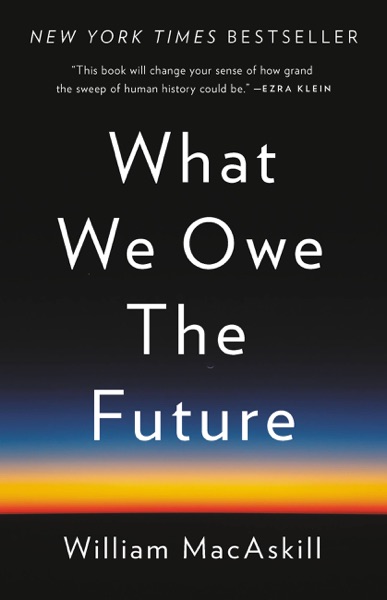
Talk to What We Owe the Future like its author wrote you back.
Get the ideas that fit your life — not generic summaries.
- Chat with the book
- Audiobook-style main ideas
- Adapts to your life and goals
- Helps you take action
What it argues
What We Owe the Future is philosopher William MacAskill's case for "longtermism" — the view that positively influencing the long-run trajectory of human civilization should be a primary moral priority. MacAskill's argument rests on scale: the number of future people who could exist if civilization continues for millions of years vastly outnumbers the present population, and if future people's lives matter morally, then even small changes to the probability of long-run flourishing represent enormous value. The book is both a philosophical argument and a practical guide to thinking about what that means.
MacAskill opens by establishing the scope of the future. If humanity survives even a modest fraction of the time the sun will continue to shine, the number of future lives dwarfs all current and past human lives combined. This is not science fiction speculation — it is simple arithmetic. The implication MacAskill draws is that premature human extinction is, by this calculus, among the worst things that could happen. Not because of what living people would lose, but because of all the people who would never exist. This is where the argument becomes controversial: it depends on a "totalist" view of population ethics that many philosophers reject, and MacAskill acknowledges the objections at length.
What it gets right
- 1.
Longtermism is the view that positively shaping the long-run future is a primary moral priority, because the number of future people who could exist vastly exceeds the current population.
- 2.
Existential risks — events that could permanently end or severely curtail civilization — deserve more attention and resources than their low probability would suggest, because their potential scale is enormous.
- 3.
Value lock-in is a distinct risk from extinction: a world permanently shaped by bad values (totalitarian, exploitative, narrow) would be a catastrophe even if it contained many people.
What it covers
Who wrote it
William MacAskill is a philosopher and associate professor at the University of Oxford, where he holds a position at the Global Priorities Institute. He co-founded the effective altruism movement and the organizations 80,000 Hours and Giving What We Can. His previous book, Doing Good Better (2015), made the case for evidence-based charitable giving. MacAskill gave away most of his income from that book and from What We Owe the Future to effective causes. He is a leading voice in the debate over how to reason about future generations and existential risk.
