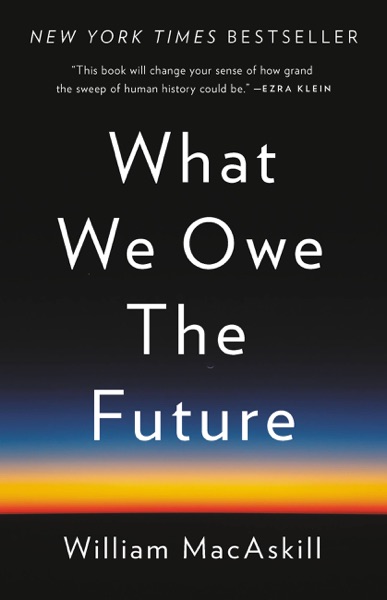
What We Owe the Future by William MacAskill is a 2022 philosophy book about longtermism, moral philosophy, existential risk. Longtermism is the view that positively shaping the long-run future is a primary moral priority, because the number of future people who could exist vastly exceeds the current population.
Summary
What We Owe the Future is philosopher William MacAskill's case for "longtermism" — the view that positively influencing the long-run trajectory of human civilization should be a primary moral priority. MacAskill's argument rests on scale: the number of future people who could exist if civilization continues for millions of years vastly outnumbers the present population, and if future people's lives matter morally, then even small changes to the probability of long-run flourishing represent enormous value. The book is both a philosophical argument and a practical guide to thinking about what that means.
MacAskill opens by establishing the scope of the future. If humanity survives even a modest fraction of the time the sun will continue to shine, the number of future lives dwarfs all current and past human lives combined. This is not science fiction speculation — it is simple arithmetic. The implication MacAskill draws is that premature human extinction is, by this calculus, among the worst things that could happen. Not because of what living people would lose, but because of all the people who would never exist. This is where the argument becomes controversial: it depends on a "totalist" view of population ethics that many philosophers reject, and MacAskill acknowledges the objections at length.
The book's second major concern is "value lock-in": the possibility that a future civilization might be permanently shaped by values dominant in the period that first gains decisive technological power. MacAskill is worried about both totalitarian lock-in (a global authoritarian regime that never relaxes its grip) and corporate lock-in (a small group of firms that entrench their values worldwide). He argues that maintaining diversity and balance of power is valuable not just instrumentally but as insurance against having the wrong values locked in.
The most concrete chapters address what individuals and institutions can do. MacAskill argues for taking existential risk from pandemics and AI seriously, for the importance of maintaining functioning institutions and democratic norms, and for the personal choice to work on neglected high-leverage problems. He applies the effective altruism framework throughout: focus where the cause is large, tractable, and neglected. The argument is that the long-run future is large, tractable enough to influence, and deeply neglected.
What We Owe the Future is a genuinely ambitious argument that takes its conclusions seriously. MacAskill does not hedge the implications: if longtermism is correct, it should reshape which careers people choose, where charitable dollars go, and how governments set priorities. Readers unconvinced by population ethics will resist the foundations, but the subsidiary arguments — about preserving institutional diversity, taking AI risk seriously, and the limits of moral overconfidence — stand somewhat independently.
Talk to What We Owe the Future like its author wrote you back.
Get the ideas that fit your life — not generic summaries.
- Chat with the book
- Audiobook-style main ideas
- Adapts to your life and goals
- Helps you take action
Key takeaways
- 1.
Longtermism is the view that positively shaping the long-run future is a primary moral priority, because the number of future people who could exist vastly exceeds the current population.
- 2.
Existential risks — events that could permanently end or severely curtail civilization — deserve more attention and resources than their low probability would suggest, because their potential scale is enormous.
- 3.
Value lock-in is a distinct risk from extinction: a world permanently shaped by bad values (totalitarian, exploitative, narrow) would be a catastrophe even if it contained many people.
- 4.
MacAskill argues for maintaining diversity and balance of power as insurance against lock-in. A world with many competing societies is more resilient than one under centralized control.
- 5.
Moral uncertainty is not a reason for inaction. MacAskill argues for a portfolio approach: act on your best current values while remaining open to revision and avoiding irreversible decisions.
- 6.
The effective altruism framework — prioritize causes that are large, tractable, and neglected — applied to the future identifies AI safety and pandemic preparedness as priority areas.
- 7.
Stagnation (permanent halt to technological and moral progress) is treated as a separate risk from extinction — a future that never becomes better is also a moral failure.
- 8.
The personal implication MacAskill draws is that career choice is one of the most important moral decisions a person makes, and it deserves serious analysis rather than default.
Discussion questions
Use these on your own, with a book club, or as chat starters in Superbook. Book club version, ready to copy or print →
- 1.
MacAskill's argument depends on future people mattering as much as present ones. Do you find that intuition compelling or does it feel like an abstraction?
- 2.
He uses scale to motivate longtermism: there could be trillions of future people. Does the sheer number of future lives override the concrete interests of current people in your view?
- 3.
What's the difference between longtermism as MacAskill presents it and ordinary long-term thinking as institutions and governments already practice it?
- 4.
The book worries about value lock-in — the wrong values becoming permanent. Who decides what 'wrong values' are, and does that problem undermine the argument?
- 5.
MacAskill acknowledges that population ethics is deeply controversial. How much does the book's argument depend on accepting a specific view of population ethics?
- 6.
He argues AI risk is one of the most pressing longtermist priorities. Does that seem right to you, and how would you compare it to climate change or pandemic risk?
- 7.
What does 'moral circle expansion' mean in the book's context, and why does MacAskill think it's important for the long run?
- 8.
Is longtermism a rebranding of consequentialism, or does it make genuinely new claims?
- 9.
The book argues career choice is a major moral decision. How would you apply the longtermist framework to your own work?
- 10.
MacAskill worries about a small group gaining decisive global control. Is there a plausible scenario in which that would be a good outcome?
- 11.
He treats institutional diversity and balance of power as intrinsic goods for the long run. What would undermine those in the next fifty years?
- 12.
Where do you think the argument is strongest and where do you think it fails?
Themes
Frequently asked questions
-
What is What We Owe the Future about?
It is MacAskill's argument that shaping humanity's long-run trajectory — reducing existential risk, preventing value lock-in, preserving diversity — is among the most morally urgent things anyone can work on, because future people vastly outnumber present people.
-
Is longtermism controversial?
Yes. The book's foundation — that future people matter as much as present ones — is a contested philosophical position, and critics have argued it can license sacrificing current welfare for speculative future benefits. MacAskill addresses these objections but does not fully resolve them.
-
Do I need a philosophy background to read this?
No. MacAskill writes clearly for a general audience and explains technical concepts. Readers without philosophy backgrounds will find it accessible, though some sections on population ethics are dense.
-
Who should read What We Owe the Future?
People thinking about career choices, charitable giving, or policy priorities who want a rigorous argument for why the long-run future should weigh heavily in those decisions. Also essential for anyone interested in AI safety, existential risk, or effective altruism.
-
What is the most actionable idea in the book?
The case for treating career choice as a major moral decision. MacAskill argues that where you work — and whether you direct your skills toward neglected high-leverage problems — matters enormously, and most people underestimate their capacity to influence which problems get solved.
Similar books
The Moral Landscape
Sam Harris
A Theory of Justice
John Rawls
The Better Angels of Our Nature
Steven Pinker
Algorithms to Live By: The Computer Science of Human Decisions
Brian Christian and Tom Griffiths
