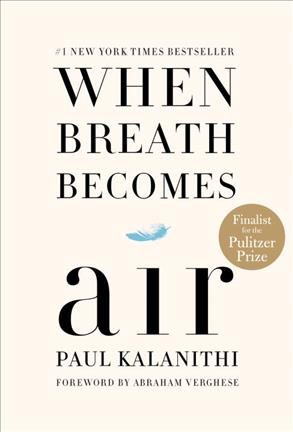
Talk to When Breath Becomes Air like its author wrote you back.
Get the ideas that fit your life — not generic summaries.
- Chat with the book
- Audiobook-style main ideas
- Adapts to your life and goals
- Helps you take action
When Breath Becomes Air, in detail
When Breath Becomes Air is Paul Kalanithi's account of his life before and after being diagnosed with stage IV lung cancer at 36, while completing his residency in neurosurgery at Stanford. Kalanithi had spent years studying literature and biology trying to answer a single question: what makes a human life meaningful? He thought he'd spend his career finding out. The diagnosis forced a different kind of reckoning — not from the outside, as a physician trying to help patients face death, but from the inside, as a patient facing it himself.
The book is structured in two parts. The first traces Kalanithi's formation: his childhood in rural Arizona, his parallel training in English literature and human biology at Stanford, and his years as a neurosurgery resident operating on the tissue that most directly encodes identity, memory, and selfhood. He writes about the particular weight of neurosurgery — how a misjudged cut can erase a personality, how the operating room demands a kind of moral seriousness that other branches of medicine can defer. This section reads less like a memoir and more like a meditation on vocation.
The second part begins with the diagnosis and follows Kalanithi through treatment, a period of remission during which he and his wife Lucy conceived a daughter, and the eventual return of the disease. He goes back to the operating room because it's what he knows how to do and because it clarifies who he still is. His daughter Cady is born eight months before he dies. The book ends with an epilogue by Lucy. The final chapters Kalanithi wrote while on oxygen. The prose doesn't falter.
What makes the book unusual among medical memoirs is the quality of its thinking. Kalanithi is genuinely trying to work something out — how to live in the time he has, what obligations he owes his patients and his family, whether a life cut short can still be complete. He draws on Tolstoy, Beckett, and T.S. Eliot not as decoration but as interlocutors. The book doesn't offer consolation or a framework for coping with mortality. It offers honest company in the attempt to face it.
The big ideas
- 1.
A physician who has guided patients through terminal diagnoses can still be blindsided by how different the experience is from the inside. Clinical training is not the same as wisdom about one's own death.
- 2.
Kalanithi argues that meaning is not found after confronting mortality but through the work you were already doing. Identity survives the diagnosis if the work survives it.
- 3.
Neurosurgery makes the mind-body problem concrete and urgent. Operating on the brain is not like operating on a liver — the tissue being cut encodes language, memory, and personality.
