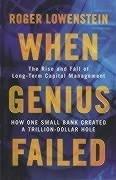
Talk to When Genius Failed like its author wrote you back.
Get the ideas that fit your life — not generic summaries.
- Chat with the book
- Audiobook-style main ideas
- Adapts to your life and goals
- Helps you take action
When Genius Failed, in detail
When Genius Failed is Roger Lowenstein's account of Long-Term Capital Management, the hedge fund that almost took down the global financial system in 1998. LTCM was founded by John Meriwether, a Salomon Brothers bond trader, and staffed with two Nobel Prize-winning economists — Myron Scholes and Robert Merton — whose options-pricing work underpinned modern derivatives theory. The fund used enormous leverage to exploit tiny pricing inefficiencies in bond markets, earned spectacular returns in its early years, and then lost nearly $4 billion in a matter of weeks when Russia defaulted on its debt and the trades that were supposed to be uncorrelated all moved against them simultaneously.
Lowenstein tells the story chronologically, beginning with Meriwether's career at Salomon and the intellectual culture that produced LTCM's models. The fund's models were built on historical data and assumed that markets would behave as they normally do. They did not account well for the possibility that correlations break down in a crisis, that liquidity dries up, or that being right about a trade matters nothing if you are forced to liquidate before the trade converges. LTCM was not wrong about the trades in a theoretical sense; it was wrong about how much leverage a strategy could sustain when everything went against it at once.
The Federal Reserve orchestrated a private-sector bailout in 1998, gathering LTCM's creditors to avoid a disorderly unwinding that threatened to cascade through global markets. The episode became a case study in systemic risk and the limits of quantitative models — lessons that were partially forgotten before the 2008 financial crisis made them urgent again.
Lowenstein writes as a journalist with the ability to make complex derivatives comprehensible without oversimplifying. The book rewards two kinds of readers: those who want a gripping narrative about financial hubris, and those who want to understand why sophisticated models fail. The answer to the latter is consistent and uncomfortable: models built on historical data cannot account for events outside that history, and leverage transforms small errors into catastrophes.
The big ideas
- 1.
Models built on historical data cannot account for events outside that history. LTCM's models were calibrated to normal markets, and 1998 was not a normal market.
- 2.
Leverage amplifies both gains and losses. LTCM was leveraged 25:1 at its peak; this turned a modest loss rate into a catastrophic capital wipeout in weeks.
- 3.
Correlations that look stable in normal markets often collapse in crises. LTCM's supposedly uncorrelated trades all moved against the fund simultaneously when Russia defaulted.
