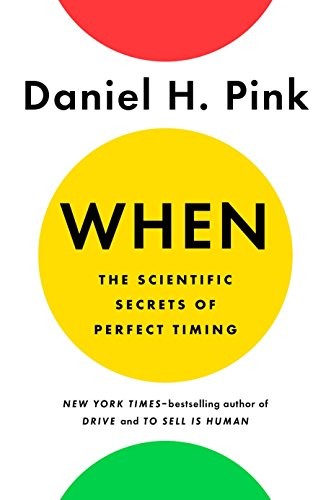
Talk to When: The Scientific Secrets of Perfect Timing like its author wrote you back.
Get the ideas that fit your life — not generic summaries.
- Chat with the book
- Audiobook-style main ideas
- Adapts to your life and goals
- Helps you take action
What it argues
When is Daniel Pink's survey of the science behind timing — not the motivational kind but the empirical kind, drawn from economics, psychology, biology, and medicine. The central claim is that when you do something matters as much as how you do it, and that people massively underestimate temporal patterns in their own performance, mood, and decision-making.
Pink organizes the book around three phases of the day that most people experience: a peak, a trough, and a recovery. Analytical, vigilant tasks belong in the peak. Administrative and routine work fits the trough. Insight and creative work is better suited to the recovery, when the brain is more loosely associative and less vigilantly filtering out unusual connections. The specific timing of these phases shifts based on your chronotype — whether you're a morning lark, a night owl, or somewhere in between — and Pink argues that knowing your type allows you to structure your day deliberately rather than accidentally.
What it gets right
- 1.
Most people have a peak, a trough, and a recovery in their daily performance. The sequence shifts based on chronotype, but the pattern holds broadly across adults.
- 2.
Analytical and vigilant work belongs in the peak phase. Creative and insight work is better suited to the recovery phase, when inhibitions loosen. The trough is the enemy of both.
- 3.
The 'fresh start effect' is real: people are significantly more likely to pursue goals at the start of a new time period — a week, a month, a birthday, a new year. Temporal landmarks reset motivation.
What it covers
Who wrote it
Daniel H. Pink is an American author and speaker who writes at the intersection of behavioral science and work. He is the author of six books, including A Whole New Mind, Drive, and To Sell Is Human, each of which became New York Times bestsellers. Before writing full-time, Pink worked as chief speechwriter for Vice President Al Gore. His work draws on academic research in psychology and economics and translates it for general readers with an emphasis on practical application to professional life.
