Summary
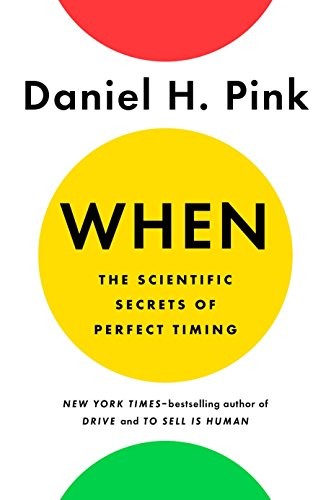
When is Daniel Pink's survey of the science behind timing — not the motivational kind but the empirical kind, drawn from economics, psychology, biology, and medicine. The central claim is that when you do something matters as much as how you do it, and that people massively underestimate temporal patterns in their own performance, mood, and decision-making.
Pink organizes the book around three phases of the day that most people experience: a peak, a trough, and a recovery. Analytical, vigilant tasks belong in the peak. Administrative and routine work fits the trough. Insight and creative work is better suited to the recovery, when the brain is more loosely associative and less vigilantly filtering out unusual connections. The specific timing of these phases shifts based on your chronotype — whether you're a morning lark, a night owl, or somewhere in between — and Pink argues that knowing your type allows you to structure your day deliberately rather than accidentally.
Beyond daily rhythms, When covers beginnings, midpoints, and endings. Beginnings create disproportionate psychological momentum: people are more likely to start fresh at temporal landmarks like Mondays, birthdays, and the start of a new year, a phenomenon Pink calls the "fresh start effect." Midpoints have a strange double effect — a sense of being behind relative to a goal energizes most people, while a sense of being ahead causes complacency. Endings prompt a drive toward completion and meaning that can override other preferences.
Pink writes in his characteristic brisk, chapter-by-chapter style, leaning heavily on studies and stripping out academic hedging. The book is more summary than argument — it doesn't build toward a single framework the way Newport or Clear do. But the accumulated findings are genuinely useful, and several chapters (the one on hospitals and medical errors caused by timing, the one on naps) are memorable on their own. For readers who want an overview of the timing literature with practical suggestions, it delivers exactly that.
Talk to When: The Scientific Secrets of Perfect Timing like its author wrote you back.
Get the ideas that fit your life — not generic summaries.
- Chat with the book
- Audiobook-style main ideas
- Adapts to your life and goals
- Helps you take action
Key takeaways
- 1.
Most people have a peak, a trough, and a recovery in their daily performance. The sequence shifts based on chronotype, but the pattern holds broadly across adults.
- 2.
Analytical and vigilant work belongs in the peak phase. Creative and insight work is better suited to the recovery phase, when inhibitions loosen. The trough is the enemy of both.
- 3.
The 'fresh start effect' is real: people are significantly more likely to pursue goals at the start of a new time period — a week, a month, a birthday, a new year. Temporal landmarks reset motivation.
- 4.
Napping strategically improves performance. The 'nappuccino' — a coffee followed immediately by a twenty-minute nap — combines the adenosine-clearing effect of sleep with caffeine's wake-up timing to produce measurable alertness improvements.
- 5.
Midpoints matter. Research on basketball halftimes and quarterly earnings calls shows that teams and organizations that are slightly behind at the midpoint outperform those that are ahead. A mild sense of lag is motivating; a large one is demoralizing.
- 6.
Endings create a drive toward meaning-making and completion. People in the final phase of any period — a job, a life stage, an episode — rate experiences differently and seek resolution more actively.
- 7.
Hospital errors, judicial decisions, and exam performance all show systematic patterns by time of day. The costs of ignoring timing aren't abstract; they show up in measurable outcomes.
- 8.
Synchrony — shared timing rituals like singing, walking in step, or meeting rhythms — increases group cohesion and cooperation in measurable ways.
Discussion questions
Use these on your own, with a book club, or as chat starters in Superbook.
- 1.
When in your day do you currently do your most demanding analytical work? Does it match when your energy and attention are actually highest?
- 2.
Pink describes peak, trough, and recovery phases. Based on your experience, when is your trough? What do you typically schedule there, and what should you schedule there instead?
- 3.
Have you ever taken advantage of a temporal landmark — a new year, a birthday, a job change — to reset a habit or behavior? Did it work, and why or why not?
- 4.
Pink argues that being slightly behind at the midpoint is motivating. Think of a project that stalled. Where were you relative to your goal at the halfway mark?
- 5.
What does the research on hospital timing and medical errors suggest about how we design high-stakes work environments and shift schedules?
- 6.
The book recommends timing difficult conversations in your peak, not your trough. What important conversation have you been putting off that you could schedule more strategically?
- 7.
Are you a morning type, an evening type, or in between? How much of your current schedule is actually designed around your chronotype?
- 8.
Pink discusses how groups synchronize through shared rituals. What timing rituals, if any, does your team or family have? What's their effect on cohesion?
- 9.
The fresh start effect works best when the landmark feels meaningful to you personally. What personal temporal landmarks do you already use, consciously or not?
- 10.
Think of a decision you made in the mid-afternoon that you later regretted. Is there a timing explanation, or was it just a bad decision?
- 11.
Endings change how people experience an entire period. How have you seen this play out in the final days of a job, a relationship, or a project?
- 12.
If you could redesign your workweek with timing science in mind, what would you move to mornings? What would you protect from the post-lunch trough?
Themes
Frequently asked questions
-
Is When by Daniel Pink worth reading?
Yes, if you want a readable survey of timing research with practical implications for structuring your day. It's lighter and less prescriptive than Deep Work but covers different ground. Readers who want a single actionable framework may find it too survey-like.
-
How long does it take to read When?
Around three to four hours at average reading pace. The chapters are short and self-contained. Many readers read it in a few sittings, though some chapters reward re-reading once you start applying the ideas.
-
What's the main takeaway from When?
When you do something matters as much as how you do it. Most people have a predictable daily performance curve — peak, trough, recovery — and aligning the right tasks to the right phase produces measurable improvements without requiring more time or willpower.
-
What is a 'nappuccino' and does it actually work?
A nappuccino is a technique where you drink coffee, then immediately take a twenty-minute nap. The caffeine takes twenty to thirty minutes to work, so you wake up just as it kicks in, clearing adenosine during sleep before the alertness boost arrives. The research Pink cites supports measurable performance gains.
-
Who should read When?
Knowledge workers, students, managers scheduling meetings, and anyone who has noticed that their performance varies significantly by time of day and wants to understand why. Also useful for people designing shift schedules or healthcare protocols where timing affects outcomes.