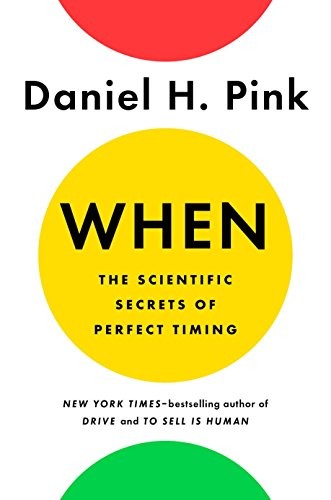
Talk to When: The Scientific Secrets of Perfect Timing like its author wrote you back.
Get the ideas that fit your life — not generic summaries.
- Chat with the book
- Audiobook-style main ideas
- Adapts to your life and goals
- Helps you take action
When: The Scientific Secrets of Perfect Timing, in detail
Daniel Pink's When, published in 2018, applies the science of chronobiology and cognitive timing to practical decisions about when to do things. The central finding is that time-of-day is not neutral: performance on cognitive tasks, mood, and vigilance follow a predictable daily pattern for most people, and ignoring that pattern comes at a cost.
The core daily pattern follows a peak-trough-rebound structure. For people with typical circadian preferences — the majority — the peak arrives in the morning, a trough in the early-to-mid afternoon, and a rebound in the late afternoon and early evening. Analytical work that requires focus and critical thinking should go in the peak. Administrative tasks and routine decisions are appropriate for the trough. Creative work that benefits from looser inhibitory control does well in the rebound.
Pink applies this framework to a range of time-sensitive decisions beyond the daily cycle. He draws on research showing that beginnings matter: people are more motivated at the start of a week, a month, a year, or after a birthday — what researchers call temporal landmarks. These fresh-start effects are real and exploitable. Similarly, endings affect how experiences are remembered. The peak-end rule from Daniel Kahneman's research shows that the most intense moment and the final moment of an experience dominate how it is evaluated and recalled, not the average.
The book also covers midpoints. Studies of basketball games, business projects, and musical competitions show that teams and individuals often rally at the perceived halfway point — they fall behind, hit the middle, and suddenly accelerate. Pink calls this the midpoint slump and its resolution, using deliberate attention to where you are in a project or endeavor can turn passive slumps into active rallies.
When is a pleasant, well-organized popular science book. It is not a deep investigation of chronobiology — that literature is treated lightly — and the prescriptions are sometimes too neat. But the core message, that time-of-day affects performance in predictable ways and that most people and organizations ignore this, is well supported and practically useful.
The big ideas
- 1.
Most people follow a peak-trough-rebound pattern across the day: cognitive performance peaks in the morning, dips sharply in the early afternoon, and recovers in the late afternoon.
- 2.
The trough — typically early to mid-afternoon — is when vigilance and analytic thinking are lowest. Scheduling important decisions or surgery for this window has measurable negative effects.
- 3.
Temporal landmarks — the start of a week, a year, a birthday — create fresh-start effects that reset motivation. People are more likely to begin new pursuits at these moments.
