When: The Scientific Secrets of Perfect Timing by Daniel H. Pink is a 2018 psychology book about timing, circadian rhythms, decision-making. Most people follow a peak-trough-rebound pattern across the day: cognitive performance peaks in the morning, dips sharply in the early afternoon, and recovers in the late afternoon.
Summary
Daniel Pink's When, published in 2018, applies the science of chronobiology and cognitive timing to practical decisions about when to do things. The central finding is that time-of-day is not neutral: performance on cognitive tasks, mood, and vigilance follow a predictable daily pattern for most people, and ignoring that pattern comes at a cost.
The core daily pattern follows a peak-trough-rebound structure. For people with typical circadian preferences — the majority — the peak arrives in the morning, a trough in the early-to-mid afternoon, and a rebound in the late afternoon and early evening. Analytical work that requires focus and critical thinking should go in the peak. Administrative tasks and routine decisions are appropriate for the trough. Creative work that benefits from looser inhibitory control does well in the rebound.
Pink applies this framework to a range of time-sensitive decisions beyond the daily cycle. He draws on research showing that beginnings matter: people are more motivated at the start of a week, a month, a year, or after a birthday — what researchers call temporal landmarks. These fresh-start effects are real and exploitable. Similarly, endings affect how experiences are remembered. The peak-end rule from Daniel Kahneman's research shows that the most intense moment and the final moment of an experience dominate how it is evaluated and recalled, not the average.
The book also covers midpoints. Studies of basketball games, business projects, and musical competitions show that teams and individuals often rally at the perceived halfway point — they fall behind, hit the middle, and suddenly accelerate. Pink calls this the midpoint slump and its resolution, using deliberate attention to where you are in a project or endeavor can turn passive slumps into active rallies.
When is a pleasant, well-organized popular science book. It is not a deep investigation of chronobiology — that literature is treated lightly — and the prescriptions are sometimes too neat. But the core message, that time-of-day affects performance in predictable ways and that most people and organizations ignore this, is well supported and practically useful.
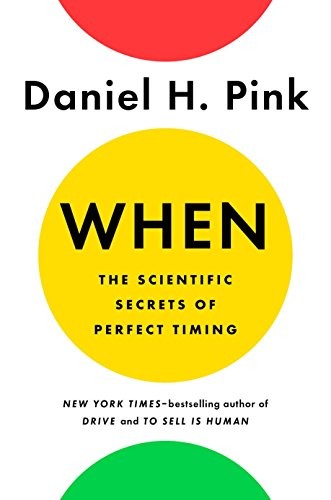
Talk to When: The Scientific Secrets of Perfect Timing like its author wrote you back.
Get the ideas that fit your life — not generic summaries.
- Chat with the book
- Audiobook-style main ideas
- Adapts to your life and goals
- Helps you take action
Key takeaways
- 1.
Most people follow a peak-trough-rebound pattern across the day: cognitive performance peaks in the morning, dips sharply in the early afternoon, and recovers in the late afternoon.
- 2.
The trough — typically early to mid-afternoon — is when vigilance and analytic thinking are lowest. Scheduling important decisions or surgery for this window has measurable negative effects.
- 3.
Temporal landmarks — the start of a week, a year, a birthday — create fresh-start effects that reset motivation. People are more likely to begin new pursuits at these moments.
- 4.
The peak-end rule: experiences are remembered not by their average quality but by their peak moment and their ending. Managing endings deliberately shapes how an experience will be evaluated.
- 5.
Midpoints matter. Teams that are slightly behind at halftime tend to outperform teams that are slightly ahead, possibly because the midpoint triggers a productive response to perceived threat.
- 6.
Breaks improve performance more than most people assume. Brief diversions restore attention and reduce the vigilance decrement that sets in with sustained effort.
- 7.
Chronotype — the natural preference for morning or evening activity — is genuinely biological, not motivational. Demanding morning productivity from evening types carries real cognitive costs.
- 8.
Social timing matters independently of individual timing. Being out of sync with the people around you — in work schedules, sleep-wake cycles, or shared rhythms — has well-documented costs to relationships and health.
Discussion questions
Use these on your own, with a book club, or as chat starters in Superbook. Book club version, ready to copy or print →
- 1.
What is your approximate chronotype — morning, intermediate, or evening? Does your daily schedule actually match it, and what would it take to change that?
- 2.
Pink argues that the trough is a real performance dip, not just perceived tiredness. Have you noticed your own trough? What are you usually doing during it?
- 3.
The peak-end rule suggests that how something ends shapes how it is remembered. Has that played out in your own experience — events that went well but ended badly, or vice versa?
- 4.
Fresh-start effects around temporal landmarks are well documented. Which fresh starts have worked for you, and which ones turned out to be motivation that dissipated within days?
- 5.
He recommends taking breaks more deliberately. What breaks have you found genuinely restorative, versus breaks that just delay work without restoring focus?
- 6.
The midpoint research suggests that people and teams rally when they recognize they are at a halfway point. Can you design your own projects to make that midpoint salient and useful?
- 7.
Pink discusses the costs of scheduling medical procedures, legal hearings, and other high-stakes activities in the afternoon trough. What structural changes would be required to fix that, and who has the incentives to make them?
- 8.
The book argues that beginnings, midpoints, and endings are psychologically distinct phases. Does that match your experience of extended projects or life transitions?
- 9.
Social jet lag — the mismatch between your chronotype and your work schedule — is common and costly. What would a workplace that took chronotype differences seriously actually look like?
- 10.
Pink writes mostly about cognition and mood. What does the timing framework say about emotional work — difficult conversations, empathy-intensive tasks, creative vulnerability?
- 11.
Is there a decision you have been putting off that is partly a timing decision in Pink's sense — not knowing when is the right moment to act?
- 12.
Which of Pink's prescriptions do you think you will actually try, and which seem impractical given your constraints?
Themes
Frequently asked questions
-
What is the main finding of When?
That time of day has a large and predictable effect on cognitive performance, mood, and vigilance, and that most people and organizations ignore this. Matching task type to the right phase of the daily cycle improves outcomes across a wide range of domains.
-
What is the trough and when does it happen?
The trough is a period of reduced vigilance, mood, and analytic performance that occurs in the early to mid-afternoon for most people. Pink recommends scheduling routine or administrative tasks during the trough and reserving mornings for analytical work.
-
Does this apply to night owls?
Yes, with the pattern shifted. Evening chronotypes have their peak later in the day, often in the late morning or afternoon, with their trough arriving in the evening. The same framework applies — just with a different schedule.
-
Is When a serious science book?
It is popular science — accessible and engaging, based on real research, but not a technical text. The chronobiology it draws on is real and well-studied; the applications are reasonable but presented with more certainty than a cautious reading of the research would fully support.
-
What is the single most useful prescription?
Protect your peak. Most people treat morning as the time to clear administrative tasks — email, meetings, routine decisions. Reversing that, so that the peak is reserved for the most demanding work and the trough handles the rest, is the biggest leverage point.
Similar books
Stumbling on Happiness
Daniel Gilbert
Thinking, Fast and Slow
Daniel Kahneman
Flow: The Psychology of Optimal Experience
Mihaly Csikszentmihalyi
The Power of Full Engagement
Jim Loehr and Tony Schwartz
