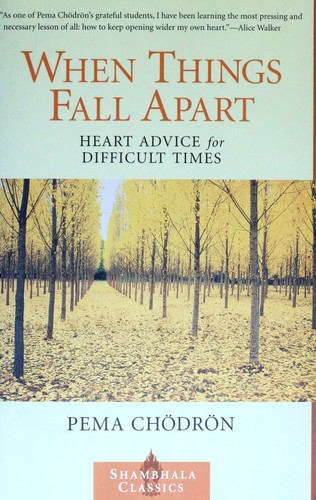
Talk to When Things Fall Apart: Heart Advice for Difficult Times like its author wrote you back.
Get the ideas that fit your life — not generic summaries.
- Chat with the book
- Audiobook-style main ideas
- Adapts to your life and goals
- Helps you take action
What it argues
When Things Fall Apart is a collection of talks and essays by Pema Chödrön, an American Buddhist nun in the Tibetan tradition, addressing how to work with difficulty, loss, and uncertainty rather than escape them. The book was largely composed after a period of personal crisis in Chödrön's own life and carries the directness of someone writing from experience rather than doctrine.
The central argument runs against most self-help instincts. Chödrön's case is that the pain we try to avoid — groundlessness, uncertainty, heartbreak — is not the enemy. It is, if we are willing to turn toward it rather than flee, the ground of genuine wakefulness. The Tibetan concept of dukkha — often translated as suffering — she frames less as a problem to solve and more as a fundamental quality of experience that resists being fixed. The project is not to eliminate discomfort but to learn to sit with it without adding the second arrow of resistance.
What it gets right
- 1.
The things that feel most threatening — groundlessness, impermanence, uncertainty — are not obstacles to a good life. They are its actual texture.
- 2.
We add suffering to pain by resisting it. The pain itself is often manageable; the struggle against the pain is where we exhaust ourselves.
- 3.
Tonglen, the practice of breathing in pain and breathing out relief, inverts the instinct to protect ourselves. It is a training in compassion through willingness to feel difficulty.
What it covers
Who wrote it
Pema Chödrön is an American Buddhist nun ordained in the Tibetan tradition. Born Deirdre Blomfield-Brown in 1936, she studied with the Tibetan teacher Chögyam Trungpa Rinpoche and later with Dzigar Kongtrul Rinpoche. She served for many years as director of Gampo Abbey, a Buddhist monastery in Nova Scotia. Her other books include The Places That Scare You, Start Where You Are, and Comfortable with Uncertainty. She is among the most widely read Western interpreters of Tibetan Buddhist practice, known for making traditional teachings accessible without flattening them.
