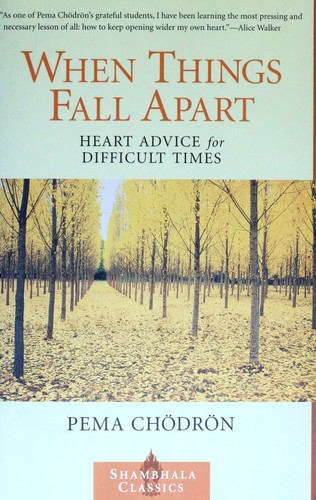
Talk to When Things Fall Apart: Heart Advice for Difficult Times like its author wrote you back.
Get the ideas that fit your life — not generic summaries.
- Chat with the book
- Audiobook-style main ideas
- Adapts to your life and goals
- Helps you take action
When Things Fall Apart: Heart Advice for Difficult Times, in detail
When Things Fall Apart is a collection of talks and essays by Pema Chödrön, an American Buddhist nun in the Tibetan tradition, addressing how to work with difficulty, loss, and uncertainty rather than escape them. The book was largely composed after a period of personal crisis in Chödrön's own life and carries the directness of someone writing from experience rather than doctrine.
The central argument runs against most self-help instincts. Chödrön's case is that the pain we try to avoid — groundlessness, uncertainty, heartbreak — is not the enemy. It is, if we are willing to turn toward it rather than flee, the ground of genuine wakefulness. The Tibetan concept of dukkha — often translated as suffering — she frames less as a problem to solve and more as a fundamental quality of experience that resists being fixed. The project is not to eliminate discomfort but to learn to sit with it without adding the second arrow of resistance.
Several chapters deal with specific practices: tonglen (sending and receiving, a meditation for extending compassion to others and oneself through pain), working with fear by leaning into its physical sensations, and the idea of "the genuine heart of sadness" — a kind of open tenderness available to people who stop armoring themselves against loss. Chödrön is not sentimental about any of this. She acknowledges that the practices she describes are difficult and that the impulse to seek solid ground is almost irresistible.
The writing is conversational and clear, adapted from talks rather than composed as literary prose. Some readers will find this warm; others will find it loose. The book is most useful in moments of actual crisis — when formal arguments feel abstract and what's needed is permission to be present with difficulty rather than instructions for eliminating it.
The big ideas
- 1.
The things that feel most threatening — groundlessness, impermanence, uncertainty — are not obstacles to a good life. They are its actual texture.
- 2.
We add suffering to pain by resisting it. The pain itself is often manageable; the struggle against the pain is where we exhaust ourselves.
- 3.
Tonglen, the practice of breathing in pain and breathing out relief, inverts the instinct to protect ourselves. It is a training in compassion through willingness to feel difficulty.
