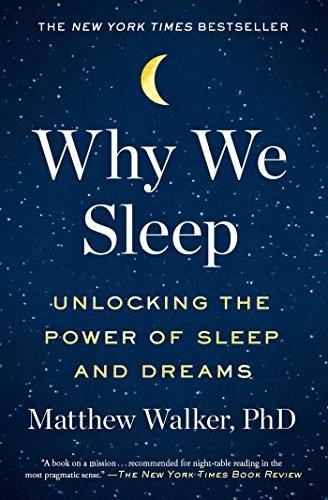
Talk to Why We Sleep like its author wrote you back.
Get the ideas that fit your life — not generic summaries.
- Chat with the book
- Audiobook-style main ideas
- Adapts to your life and goals
- Helps you take action
Why We Sleep, in detail
Why We Sleep is Matthew Walker's attempt to do for sleep what no amount of public health messaging has managed: make people genuinely afraid of what they're losing. Walker is a sleep scientist at UC Berkeley, and the book functions as a comprehensive argument that most adults in industrialized countries are chronically sleep-deprived in ways they don't recognize and can't compensate for. The thesis is blunt — sleep is not a passive recovery state but an active biological process that does things no other intervention can replicate.
Walker covers both NREM (non-rapid eye movement) and REM sleep in enough detail to make the biology legible without requiring a neuroscience background. NREM sleep, particularly slow-wave sleep in the early part of the night, consolidates factual memories and clears metabolic waste from the brain via the glymphatic system. REM sleep, concentrated in the later hours, processes emotional memories and drives creative insight — it's the stage you lose most when you cut a night short. The two stages don't substitute for each other. Sleeping six hours instead of eight doesn't give you 75% of the benefit; it collapses certain functions almost entirely.
The health case Walker builds is genuinely alarming. Short sleep is associated with elevated risk of cardiovascular disease, obesity, diabetes, Alzheimer's, cancer, and immune dysfunction. He details the research on each, including studies showing that regularly sleeping less than six hours raises all-cause mortality risk to a statistically meaningful degree. He also covers the cognitive costs: after seventeen hours awake, human performance degrades to a level equivalent to a blood alcohol content above the legal driving limit, and the impaired individual typically cannot perceive the impairment. Caffeine doesn't restore cognitive capacity; it suppresses the adenosine signal that creates the urge to sleep, but the debt accumulates regardless.
The book has attracted criticism on two fronts. Some researchers have noted that Walker occasionally overstates effect sizes and causal certainty where the underlying studies show association rather than causation. The prescriptive section on sleep hygiene — consistent wake time, cool dark room, no alcohol before bed, no screens — is sensible but not new. Still, Walker's synthesis of the full research landscape in one readable volume is its real contribution. The case that most people are operating with a significant and measurable deficit, without knowing it, is hard to dismiss even after accounting for the overstated claims.
The big ideas
- 1.
Sleep is not passive recovery. During NREM sleep the brain consolidates memories and clears waste; during REM it processes emotions and drives creative problem-solving. Both are necessary and neither substitutes for the other.
- 2.
Sleeping less than seven hours a night degrades cognitive performance measurably within days. After seventeen continuous hours awake, impairment equals a 0.05% blood alcohol level — above the legal driving limit in many countries.
- 3.
The glymphatic system flushes toxic metabolic byproducts, including amyloid beta associated with Alzheimer's, primarily during deep slow-wave sleep. Chronic short sleep may accelerate neurodegeneration.
