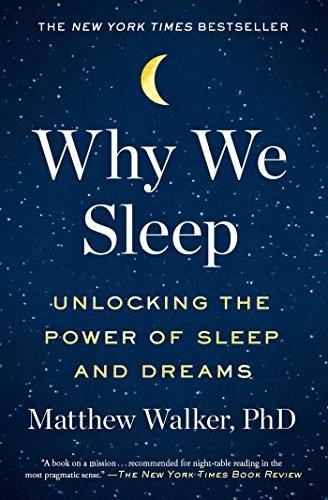
Why We Sleep by Matthew Walker is a 2017 science book about sleep, health, neuroscience. Sleep is not passive recovery. During NREM sleep the brain consolidates memories and clears waste; during REM it processes emotions and drives creative problem-solving. Both are necessary and neither substitutes for the other.
Summary
Why We Sleep is Matthew Walker's attempt to do for sleep what no amount of public health messaging has managed: make people genuinely afraid of what they're losing. Walker is a sleep scientist at UC Berkeley, and the book functions as a comprehensive argument that most adults in industrialized countries are chronically sleep-deprived in ways they don't recognize and can't compensate for. The thesis is blunt — sleep is not a passive recovery state but an active biological process that does things no other intervention can replicate.
Walker covers both NREM (non-rapid eye movement) and REM sleep in enough detail to make the biology legible without requiring a neuroscience background. NREM sleep, particularly slow-wave sleep in the early part of the night, consolidates factual memories and clears metabolic waste from the brain via the glymphatic system. REM sleep, concentrated in the later hours, processes emotional memories and drives creative insight — it's the stage you lose most when you cut a night short. The two stages don't substitute for each other. Sleeping six hours instead of eight doesn't give you 75% of the benefit; it collapses certain functions almost entirely.
The health case Walker builds is genuinely alarming. Short sleep is associated with elevated risk of cardiovascular disease, obesity, diabetes, Alzheimer's, cancer, and immune dysfunction. He details the research on each, including studies showing that regularly sleeping less than six hours raises all-cause mortality risk to a statistically meaningful degree. He also covers the cognitive costs: after seventeen hours awake, human performance degrades to a level equivalent to a blood alcohol content above the legal driving limit, and the impaired individual typically cannot perceive the impairment. Caffeine doesn't restore cognitive capacity; it suppresses the adenosine signal that creates the urge to sleep, but the debt accumulates regardless.
The book has attracted criticism on two fronts. Some researchers have noted that Walker occasionally overstates effect sizes and causal certainty where the underlying studies show association rather than causation. The prescriptive section on sleep hygiene — consistent wake time, cool dark room, no alcohol before bed, no screens — is sensible but not new. Still, Walker's synthesis of the full research landscape in one readable volume is its real contribution. The case that most people are operating with a significant and measurable deficit, without knowing it, is hard to dismiss even after accounting for the overstated claims.
Talk to Why We Sleep like its author wrote you back.
Get the ideas that fit your life — not generic summaries.
- Chat with the book
- Audiobook-style main ideas
- Adapts to your life and goals
- Helps you take action
Key takeaways
- 1.
Sleep is not passive recovery. During NREM sleep the brain consolidates memories and clears waste; during REM it processes emotions and drives creative problem-solving. Both are necessary and neither substitutes for the other.
- 2.
Sleeping less than seven hours a night degrades cognitive performance measurably within days. After seventeen continuous hours awake, impairment equals a 0.05% blood alcohol level — above the legal driving limit in many countries.
- 3.
The glymphatic system flushes toxic metabolic byproducts, including amyloid beta associated with Alzheimer's, primarily during deep slow-wave sleep. Chronic short sleep may accelerate neurodegeneration.
- 4.
REM sleep is concentrated in the final hours of an eight-hour window. Cutting sleep to six hours doesn't shave the first two hours — it removes almost all REM sleep, collapsing emotional regulation and creative processing.
- 5.
Caffeine doesn't repay sleep debt. It blocks adenosine receptors temporarily, masking the fatigue signal, but the underlying debt accumulates and rebounds when the caffeine clears.
- 6.
Alcohol suppresses REM sleep. Even moderate drinking before bed produces fragmented, non-restorative sleep while appearing to help you fall asleep faster.
- 7.
Chronic sleep deprivation is largely invisible to the sufferer. People who consistently sleep six hours report feeling fine while performing measurably worse than they did when sleeping eight.
- 8.
Sleep deprivation is associated with elevated risk of cardiovascular disease, obesity, type 2 diabetes, certain cancers, and immune dysfunction. Walker argues the relationship is causal in several pathways, not merely correlational.
Discussion questions
Use these on your own, with a book club, or as chat starters in Superbook. Book club version, ready to copy or print →
- 1.
Walker claims most people can't accurately assess their own level of impairment from sleep loss. Has there been a period in your life where you were clearly sleep-deprived but convinced you were functioning fine?
- 2.
The book argues that REM sleep is where emotional memory is processed and painful experiences lose their sting. What does that suggest about how people should think about the sleep they get after a difficult event?
- 3.
Walker is critical of napping as a substitute for sufficient night sleep, but some cultures and workplaces have embraced it. How do you think about napping in your own life — compensatory, preventative, or neither?
- 4.
Caffeine is the most widely consumed psychoactive drug in the world, largely used to override natural sleep pressure. How would your daily routine change if you treated caffeine as Walker describes — a debt instrument, not an energy source?
- 5.
The book details how alcohol disrupts REM sleep even in moderate amounts. Does this change how you think about the trade-off between the relaxation benefit of a drink before bed and its effect on sleep quality?
- 6.
Walker argues that alarm clocks are fundamentally at odds with healthy sleep because they interrupt the natural sleep cycle. How much of your current sleep schedule is determined by obligation versus biology?
- 7.
Schools and workplaces are organized around morning schedules that conflict with adolescent and adult circadian biology. Who bears the cost of that structural mismatch, and what would it take to change it?
- 8.
The association between short sleep and Alzheimer's risk is one of the book's more alarming claims. Does knowing that sleep clears amyloid plaques from the brain change anything about how you prioritize it?
- 9.
Walker draws a distinction between being unable to sleep (insomnia) and choosing not to sleep (voluntary restriction). Which one describes the pattern you recognize most in people around you, and in yourself?
- 10.
The book attributes much of the chronic sleep deprivation in modern societies to electric light, technology, and work culture rather than individual choice. Does framing it as a structural problem change how you think about your own sleep habits?
- 11.
Walker claims that consistently sleeping eight hours is correlated with better performance across almost every measurable domain. What would you have to change about your schedule to actually test that claim for a month?
- 12.
Some readers find the health risk data in the book motivating; others find it paralyzing. How do you respond to strongly alarming health information, and does that affect how seriously you take the prescriptions?
Themes
Frequently asked questions
-
Is Why We Sleep worth reading?
Yes, if you want a thorough argument for taking sleep seriously backed by research. Walker's synthesis is the most comprehensive popular account of sleep science available. It has weaknesses — some effect sizes are overstated and the causal claims sometimes outrun the studies — but the core picture it paints of how sleep works and what chronic deprivation costs is well-supported and important.
-
How long does it take to read Why We Sleep?
Around eight to nine hours at average reading pace for the 360-page book. It's denser than most popular science titles. The early chapters on sleep biology reward slow reading; the later chapters on health risks are more accessible.
-
What is the main argument of Why We Sleep?
Most adults in industrialized societies are chronically sleep-deprived, the deprivation is largely invisible to them, and the long-term health and cognitive costs are severe. Walker argues that sleep is not a lifestyle choice to optimize but a biological necessity as fundamental as food and water.
-
Who should read Why We Sleep?
Anyone who routinely sleeps less than seven hours, treats that as normal, and is curious whether it's actually fine. Also useful for parents of teenagers, managers who normalize overwork, and anyone in a field where performance depends on sustained cognitive quality.
-
Has Why We Sleep been criticized by scientists?
Yes. Alexey Guzey and others have documented cases where Walker misrepresented studies, overstated risk magnitudes, and presented associations as causal. Walker has acknowledged some errors. The criticism is worth knowing about, but it doesn't undermine the book's central point that most people are sleeping less than their biology requires.