Talk to Why Zebras Don't Get Ulcers like its author wrote you back.
Get the ideas that fit your life — not generic summaries.
- Chat with the book
- Audiobook-style main ideas
- Adapts to your life and goals
- Helps you take action
What it argues
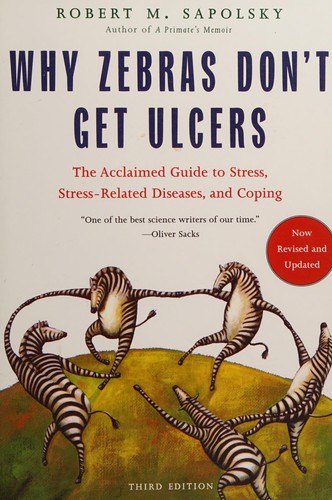
Why Zebras Don't Get Ulcers is Robert Sapolsky's definitive popular account of the biology of stress. Sapolsky is a professor of biology and neuroscience at Stanford, a MacArthur Fellow, and one of the most engaging science writers working today, and the book synthesizes decades of research on the stress response — what it is, how it evolved, and why the same system that helps a zebra escape a lion is slowly killing modern humans who never encounter lions.
The central paradox is the book's title: zebras and other prey animals face regular, genuine threats to their lives, yet they do not develop the stress-related diseases that afflict humans. This is because the zebra's stress response is acute — it mobilizes the body for a sprint, the threat resolves, and the system returns to baseline. Humans, by contrast, have the cognitive capacity to anticipate threats, ruminate on past events, and worry about social status, finances, and mortality — none of which can be resolved by running. The result is chronic activation of a system evolved for short-term emergencies.
What it gets right
- 1.
The stress response evolved for acute physical emergencies — it mobilizes energy, enhances immune response, and sharpens focus — but produces damage when activated chronically by psychological threats that cannot be resolved through physical action.
- 2.
Chronic stress damages the cardiovascular system through sustained blood pressure elevation, arterial inflammation, and altered lipid metabolism — the physiological pathway from stress to heart disease.
- 3.
The immune system is initially enhanced by acute stress but chronically suppressed by sustained stress — explaining why stressed people get sick more easily and heal more slowly.
What it covers
Who wrote it
Robert M. Sapolsky is a professor of biology, neurology, and neurological sciences at Stanford University, where he has taught since 1988. He is also a research associate with the Institute of Primate Research at the National Museums of Kenya, where he has studied a population of wild baboons in the Masai Mara for over four decades. He is a MacArthur Fellowship recipient and the author of several other books, including A Primate's Memoir, The Trouble with Testosterone, and Behave: The Biology of Humans at Our Best and Worst. Why Zebras Don't Get Ulcers, first published in 1994 and now in its third edition, is his most widely read work and is used as a text in college biology…
