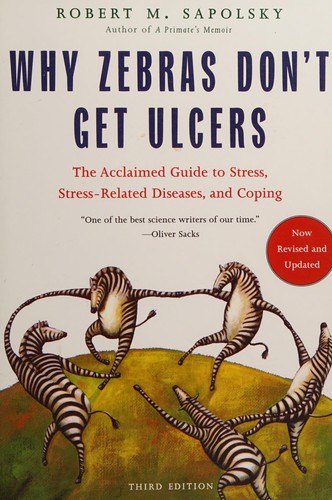
Why Zebras Don't Get Ulcers by Robert M. Sapolsky is a 1994 health book about stress, physiology, chronic disease. The stress response evolved for acute physical emergencies — it mobilizes energy, enhances immune response, and sharpens focus — but produces damage when activated chronically by psychological threats that cannot be resolved through physical action.
Summary
Why Zebras Don't Get Ulcers is Robert Sapolsky's definitive popular account of the biology of stress. Sapolsky is a professor of biology and neuroscience at Stanford, a MacArthur Fellow, and one of the most engaging science writers working today, and the book synthesizes decades of research on the stress response — what it is, how it evolved, and why the same system that helps a zebra escape a lion is slowly killing modern humans who never encounter lions.
The central paradox is the book's title: zebras and other prey animals face regular, genuine threats to their lives, yet they do not develop the stress-related diseases that afflict humans. This is because the zebra's stress response is acute — it mobilizes the body for a sprint, the threat resolves, and the system returns to baseline. Humans, by contrast, have the cognitive capacity to anticipate threats, ruminate on past events, and worry about social status, finances, and mortality — none of which can be resolved by running. The result is chronic activation of a system evolved for short-term emergencies.
Sapolsky covers the downstream effects of chronic stress on every major body system: the cardiovascular system (elevated blood pressure, arterial damage), the immune system (initial enhancement followed by suppression), the reproductive system (reduced fertility, impaired libido), the digestive system (ulcers, irritable bowel), growth and repair (stunted development, delayed healing), and the brain (hippocampal damage, impaired memory, accelerated cognitive aging). The mechanisms are explained with the precision of a scientist and the accessibility of a teacher who genuinely wants to be understood.
The final sections address individual differences in stress response and what can be done. Sapolsky covers how social status shapes the stress response (low-status individuals in hierarchical social groups show chronic physiological stress markers even in the absence of immediate threat), how perceived control and predictability reduce the stress response even when nothing materially changes, and the evidence for stress management interventions — social support, exercise, controllability, and reappraisal. The book doesn't promise stress elimination but offers a framework for understanding why some people weather the same stressors better than others.
Talk to Why Zebras Don't Get Ulcers like its author wrote you back.
Get the ideas that fit your life — not generic summaries.
- Chat with the book
- Audiobook-style main ideas
- Adapts to your life and goals
- Helps you take action
Key takeaways
- 1.
The stress response evolved for acute physical emergencies — it mobilizes energy, enhances immune response, and sharpens focus — but produces damage when activated chronically by psychological threats that cannot be resolved through physical action.
- 2.
Chronic stress damages the cardiovascular system through sustained blood pressure elevation, arterial inflammation, and altered lipid metabolism — the physiological pathway from stress to heart disease.
- 3.
The immune system is initially enhanced by acute stress but chronically suppressed by sustained stress — explaining why stressed people get sick more easily and heal more slowly.
- 4.
The hippocampus — critical for memory formation — is damaged by sustained cortisol exposure, providing a physiological mechanism for the cognitive impairment and memory problems associated with chronic stress.
- 5.
Perceived control and predictability reduce the stress response even when objective circumstances are unchanged — the perception of having options reduces cortisol more than options that exist but are not perceived.
- 6.
Social status profoundly shapes chronic stress levels: in hierarchical social groups, low-status individuals show elevated baseline glucocorticoids and stress-related health outcomes regardless of actual threat.
- 7.
Social support buffers the physiological stress response — humans with strong social connections show more modulated cortisol responses and better health outcomes under equivalent objective stressors.
- 8.
Exercise reduces the stress response by depleting the energy mobilized by cortisol and training the system to return to baseline more efficiently after activation.
Discussion questions
Use these on your own, with a book club, or as chat starters in Superbook. Book club version, ready to copy or print →
- 1.
Sapolsky's central comparison is between zebras (acute stress) and humans (chronic stress). What in your life most clearly represents the human version of psychological stress that never fully resolves?
- 2.
He argues that the stress response evolved for short-term physical emergencies and is mismatched to the social and psychological stressors of modern life. Is there any way to use physical activity to discharge the energy your stress response mobilizes?
- 3.
The book shows that perceived control reduces the stress response even when nothing objectively changes. Are there stressors in your life where increasing your sense of control — even through reappraisal — would reduce their impact?
- 4.
Sapolsky covers how social status shapes baseline stress levels. Do you think about your own social status and its effects on your physiology? Does the research change how you think about hierarchy in your workplace or social life?
- 5.
He argues that social support is one of the most powerful buffers of the stress response. How does the quality and quantity of your social connections compare to what the research suggests would be optimal?
- 6.
The evidence that chronic stress damages the hippocampus — the memory center — is striking. Does knowing that stress physically alters the brain change how urgently you treat stress management?
- 7.
Why Zebras Don't Get Ulcers was first published in 1994. How much has changed in stress research since then, and what aspects of Sapolsky's framework do you think are most durable?
- 8.
He covers the physiology of how exercise reduces stress. Does understanding the mechanism — cortisol clearance, system recalibration — change how you think about exercise as a stress management tool?
- 9.
Sapolsky is unusually funny for a stress researcher. Does the humor make the dark subject matter more or less bearable to engage with?
- 10.
He covers how early life adversity shapes the stress response permanently. What are the implications of that for how societies should invest in early childhood care?
- 11.
The book argues that predictability reduces the stress response. What domains of your life would benefit from more structure and predictability, and what are the costs of achieving that?
- 12.
If you could implement one stress-reduction practice based on the book's evidence, what would it be and what's preventing you from doing so?
Themes
Frequently asked questions
-
Is Why Zebras Don't Get Ulcers still up to date?
The third edition (2004) remains highly relevant — the core biology of the stress response is stable and Sapolsky's account of it is still among the best. Some specific findings on topics like stress and immunity have been updated by subsequent research, but the overall framework and most of the specific claims hold up.
-
Is Why Zebras Don't Get Ulcers written for scientists or general readers?
General readers, despite covering detailed physiology and neuroscience. Sapolsky is one of the best science communicators working, and the book is full of humor and vivid examples. The technical content is real but it is presented in a way that requires no scientific background.
-
What is the main practical takeaway from Why Zebras Don't Get Ulcers?
That chronic psychological stress causes measurable, progressive physical damage, and that the tools for managing it — social connection, exercise, perceived control, predictability, and stress reappraisal — are accessible and evidence-based. The book is more useful for understanding why stress is harmful than for a step-by-step stress reduction program.
-
How does Why Zebras Don't Get Ulcers relate to The Body Keeps the Score?
Both cover the physical effects of psychological stress on the body. Sapolsky focuses on the biology of the normal stress response and its chronic effects. Van der Kolk focuses specifically on traumatic stress and its consequences for memory, identity, and physical symptom expression. Sapolsky is broader and more physiological; Van der Kolk is more clinical and trauma-focused.
-
Who should read Why Zebras Don't Get Ulcers?
Anyone who wants to understand the biology of stress rather than just its psychological management. Particularly useful for people who already know they are chronically stressed and want to understand why it matters physiologically, or who find the stress-is-bad-for-you message unconvincing without understanding the mechanism.