Talk to You Are Not So Smart like its author wrote you back.
Get the ideas that fit your life — not generic summaries.
- Chat with the book
- Audiobook-style main ideas
- Adapts to your life and goals
- Helps you take action
What it argues
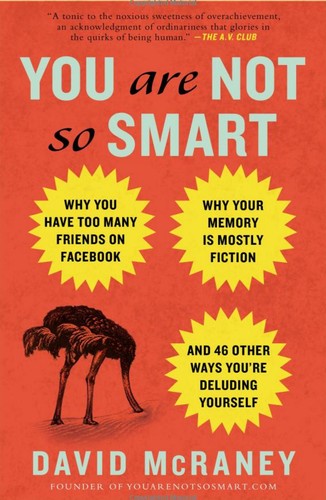
David McRaney is a journalist who started a blog called "You Are Not So Smart" about self-delusion in 2009, and turned it into this book in 2011. Each chapter pairs a false belief — something most people believe about themselves or their reasoning — with the actual psychology behind it. The format is direct: the chapter opens with the delusion ("You believe you know why you do the things you do") and then explains the research that shows you probably don't.
The chapters cover a wide range of topics: the backfire effect (encountering evidence against a belief sometimes strengthens it), the just-world hypothesis (people tend to believe victims deserved what happened to them), procrastination (we discount future versions of ourselves), the spotlight effect (we overestimate how much others notice our mistakes and successes), and the Dunning-Kruger effect (incompetence prevents accurate assessment of one's own incompetence). Each is written as a short, accessible essay that draws on the academic literature without presenting it in full.
What it gets right
- 1.
The backfire effect: when confronting a strong belief with contradicting evidence, people sometimes strengthen rather than revise the belief. The challenge is experienced as an attack on identity.
- 2.
The just-world hypothesis: believing the world is fair leads people to blame victims of misfortune for their suffering, preserving the illusion that bad things happen to people who deserve them.
- 3.
Procrastination is not laziness but a failure of self-regulation involving the discounting of future rewards. We treat our future selves as strangers and steal resources from them.
What it covers
Who wrote it
David McRaney is an American journalist and author who began the You Are Not So Smart blog in 2009 as an investigation of self-delusion. The blog became a podcast, then this book, then a second book, You Are Now Less Dumb. He has written for various publications on psychology and media literacy, and the podcast continues to produce new episodes with researchers discussing cognitive biases and social psychology. He is based in Mississippi.
