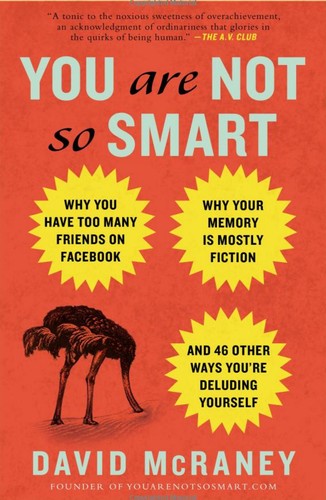
You Are Not So Smart by David McRaney is a 2011 psychology book about self-delusion, cognitive bias, reasoning. The backfire effect: when confronting a strong belief with contradicting evidence, people sometimes strengthen rather than revise the belief. The challenge is experienced as an attack on identity.
Summary
David McRaney is a journalist who started a blog called "You Are Not So Smart" about self-delusion in 2009, and turned it into this book in 2011. Each chapter pairs a false belief — something most people believe about themselves or their reasoning — with the actual psychology behind it. The format is direct: the chapter opens with the delusion ("You believe you know why you do the things you do") and then explains the research that shows you probably don't.
The chapters cover a wide range of topics: the backfire effect (encountering evidence against a belief sometimes strengthens it), the just-world hypothesis (people tend to believe victims deserved what happened to them), procrastination (we discount future versions of ourselves), the spotlight effect (we overestimate how much others notice our mistakes and successes), and the Dunning-Kruger effect (incompetence prevents accurate assessment of one's own incompetence). Each is written as a short, accessible essay that draws on the academic literature without presenting it in full.
What distinguishes McRaney's approach from other bias catalogs is his focus on the first person. The book does not primarily diagnose others — it is written to the reader as an investigation of your own irrationality. The tone is frank but not superior: McRaney presents himself as equally subject to these tendencies and is interested in the mechanisms rather than the embarrassment.
The book grew from a popular culture blog, which shows in its tone and its examples — the references are more contemporary, the examples more drawn from everyday digital life than the standard academic examples. This makes it accessible to readers who find cognitive psychology textbooks dry, though it also means the treatment of any single bias is thinner than in dedicated academic sources. It is a good starting point for the subject rather than a comprehensive account of it.
Talk to You Are Not So Smart like its author wrote you back.
Get the ideas that fit your life — not generic summaries.
- Chat with the book
- Audiobook-style main ideas
- Adapts to your life and goals
- Helps you take action
Key takeaways
- 1.
The backfire effect: when confronting a strong belief with contradicting evidence, people sometimes strengthen rather than revise the belief. The challenge is experienced as an attack on identity.
- 2.
The just-world hypothesis: believing the world is fair leads people to blame victims of misfortune for their suffering, preserving the illusion that bad things happen to people who deserve them.
- 3.
Procrastination is not laziness but a failure of self-regulation involving the discounting of future rewards. We treat our future selves as strangers and steal resources from them.
- 4.
The spotlight effect: we consistently overestimate how much other people notice our appearance, mistakes, and behavior. Others are far less focused on us than we assume.
- 5.
The Dunning-Kruger effect: incompetence in a domain prevents accurate assessment of one's own incompetence in that domain. The skills needed to evaluate performance are the same skills that performance requires.
- 6.
Confabulation: asked why we made a choice, we generate a plausible story rather than accurately reporting the process. We often do not know why we did what we did.
- 7.
The third-person effect: people consistently believe they are less susceptible to advertising and media influence than others are. This belief does not track actual susceptibility.
Discussion questions
Use these on your own, with a book club, or as chat starters in Superbook. Book club version, ready to copy or print →
- 1.
McRaney focuses on self-delusion rather than external error. Which of the biases he describes is most uncomfortable to recognize in yourself?
- 2.
The backfire effect suggests that confronting false beliefs with evidence can strengthen them. What does that imply for how you try to change someone's mind?
- 3.
The just-world hypothesis produces victim-blaming. Can you identify a case where you have explained someone's misfortune in terms of their choices rather than their circumstances?
- 4.
Procrastination as self-regulation failure means we steal from our future selves. How do you think about the relationship between your present choices and the future person who will live with them?
- 5.
The Dunning-Kruger effect says incompetence blocks accurate self-assessment. What domains are you confident in? What would genuine external assessment of those domains reveal?
- 6.
He argues that we confabulate reasons for our choices rather than reporting actual decision processes. Can you think of a recent choice where you told a story about why you made it that may not have been the actual cause?
- 7.
The spotlight effect says we overestimate how much others are watching us. How does knowing this change how you behave in public or professional settings?
- 8.
The book was adapted from a blog. Does the shorter, essay format of each chapter feel like enough treatment of each topic, or do you want more depth?
- 9.
McRaney presents himself as subject to the same biases he describes. Does that approach increase his credibility or reduce it?
- 10.
Which chapter describes a pattern you have observed most consistently in others, not just yourself?
- 11.
If you could inoculate a teenager against one of the tendencies McRaney describes, which would you choose and why?
Themes
Frequently asked questions
-
What is the Dunning-Kruger effect?
The finding that people with low ability in a domain tend to overestimate their ability, while people with high ability tend to underestimate it. The original research by David Dunning and Justin Kruger showed this in college students asked to assess their performance on logic and grammar tests.
-
Is the backfire effect real?
The original finding has not replicated cleanly. More recent research suggests that encountering corrective information usually does reduce false beliefs, though the reduction may be smaller than hoped. McRaney has revised his account of this on the podcast as the literature has evolved.
-
Is this a book for psychologists or general readers?
General readers entirely. McRaney writes as a journalist for a broad audience, with minimal technical vocabulary and examples drawn from everyday life. It requires no background in psychology.
-
How does this differ from Thinking, Fast and Slow?
Kahneman's book is the scientific foundation; McRaney's applies and popularizes it. Kahneman is more theoretically rigorous and covers fewer topics in more depth. McRaney covers more ground in a more conversational tone.
-
What is the most practically useful bias in the book?
The procrastination chapter, which reframes procrastination as a relationship between present and future selves rather than a character defect. Thinking of your future self as a real person who will bear the consequences of present choices is a useful reframe for many people.
Similar books
The Art of Thinking Clearly
Rolf Dobelli
Thinking, Fast and Slow
Daniel Kahneman
Mistakes Were Made (But Not by Me)
Carol Tavris and Elliot Aronson
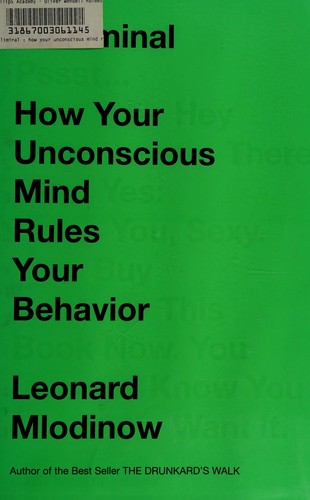
Subliminal: How Your Unconscious Mind Rules Your Behavior
Leonard Mlodinow
