Talk to Younger Next Year like its author wrote you back.
Get the ideas that fit your life — not generic summaries.
- Chat with the book
- Audiobook-style main ideas
- Adapts to your life and goals
- Helps you take action
What it argues
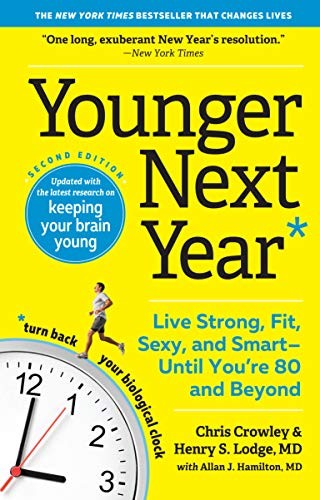
Younger Next Year is the book that resulted when Chris Crowley, a retired New York lawyer in his mid-sixties, and Henry Lodge, his internist, decided to write down the case Lodge had been making in his practice for years: that the physical and cognitive decline most people experience in the second half of life is not inevitable, and that exercise is the most powerful tool available to interrupt it. The book alternates chapters between Crowley writing from personal experience and Lodge writing as a clinician and researcher. The combination is unusually effective — Lodge provides the science and Crowley demonstrates that a non-athlete late in life can actually apply it.
Lodge's core argument draws on evolutionary biology. He proposes that the human body has two biological modes: growth and decay. Growth mode is triggered by physical exertion and social connection; decay mode is the default state when those signals are absent. Most people who "age normally" are not experiencing inevitable biological decline — they are experiencing chronic decay because they are sending no signals to grow. The mechanisms he describes involve cytokines, the chemical messengers cells use to communicate, and how exercise floods the system with growth signals while sedentary living floods it with decay signals.
What it gets right
- 1.
Most physical decline in later life is not inevitable — it is the result of chronic inactivity triggering biological decay signals rather than irreversible cellular aging.
- 2.
Exercise sends growth signals at the cellular level through cytokines and other messengers, triggering repair, building new capillaries, and maintaining neuroplasticity in the brain.
- 3.
The prescription is six days of exercise per week: four aerobic at real intensity and two days of strength training. Gentle activity doesn't produce the biological signal that prevents decay.
What it covers
Who wrote it
Chris Crowley is a retired attorney and former partner at a New York law firm who began writing about aging and fitness in his mid-sixties after his internist Henry Lodge convinced him to take exercise seriously. He went on to become an avid cyclist and skier and co-authored the Younger Next Year series with Lodge, including a companion volume for women and sequels on strength, sex, and emotional health. Lodge, who wrote the scientific chapters, was a Columbia-trained internist in Manhattan who died in 2017. Crowley has continued writing and speaking about aging since Lodge's death.
