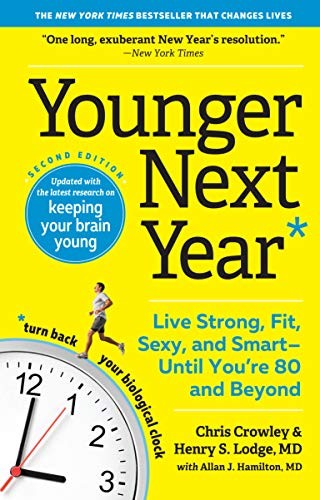
Younger Next Year by Chris Crowley is a 2004 health book about aging, exercise, longevity. Most physical decline in later life is not inevitable — it is the result of chronic inactivity triggering biological decay signals rather than irreversible cellular aging.
Summary
Younger Next Year is the book that resulted when Chris Crowley, a retired New York lawyer in his mid-sixties, and Henry Lodge, his internist, decided to write down the case Lodge had been making in his practice for years: that the physical and cognitive decline most people experience in the second half of life is not inevitable, and that exercise is the most powerful tool available to interrupt it. The book alternates chapters between Crowley writing from personal experience and Lodge writing as a clinician and researcher. The combination is unusually effective — Lodge provides the science and Crowley demonstrates that a non-athlete late in life can actually apply it.
Lodge's core argument draws on evolutionary biology. He proposes that the human body has two biological modes: growth and decay. Growth mode is triggered by physical exertion and social connection; decay mode is the default state when those signals are absent. Most people who "age normally" are not experiencing inevitable biological decline — they are experiencing chronic decay because they are sending no signals to grow. The mechanisms he describes involve cytokines, the chemical messengers cells use to communicate, and how exercise floods the system with growth signals while sedentary living floods it with decay signals.
The practical prescription is demanding: exercise six days a week, with at least four of those days being aerobic exercise at meaningful intensity, and the other two doing serious strength training. Lodge is specific about what "serious" means — not a gentle walk or a few sets of curls, but sustained exertion that genuinely challenges the cardiovascular system. He argues that the difference between people who age well and those who don't is not genetics for most people — it is whether they exercised seriously and consistently in middle age and beyond.
The book is also frank about emotional and relational dimensions of aging, which Crowley addresses with more candor than most health books manage. There is a chapter on the importance of deep social connection, one on the psychological challenges of moving from a high-status career identity to retirement, and one on sex and intimacy in later life. Lodge's biological framework extends here too: emotional engagement and connection send growth signals just as physical exercise does. For readers in their forties through seventies who want to understand what they can actually control about how they age, this is one of the most practically useful books available.
Talk to Younger Next Year like its author wrote you back.
Get the ideas that fit your life — not generic summaries.
- Chat with the book
- Audiobook-style main ideas
- Adapts to your life and goals
- Helps you take action
Key takeaways
- 1.
Most physical decline in later life is not inevitable — it is the result of chronic inactivity triggering biological decay signals rather than irreversible cellular aging.
- 2.
Exercise sends growth signals at the cellular level through cytokines and other messengers, triggering repair, building new capillaries, and maintaining neuroplasticity in the brain.
- 3.
The prescription is six days of exercise per week: four aerobic at real intensity and two days of strength training. Gentle activity doesn't produce the biological signal that prevents decay.
- 4.
Aerobic exercise in particular is neuroprotective. Regular cardiovascular exercise maintains cognitive function, memory, and mood into very old age through mechanisms that pharmaceuticals don't replicate.
- 5.
Social connection and emotional engagement are biologically equivalent to exercise in the signals they send. Isolation and disengagement accelerate decay just as physical inactivity does.
- 6.
The transition from career to retirement is a biological vulnerability. Without a replacement for the daily structure and purpose of work, the decay signals can become overwhelming.
- 7.
Strength training in later life maintains not just muscle mass but the connective tissue and bone density that determine whether falls and injuries become catastrophic.
- 8.
Crowley's experience demonstrates that starting serious exercise in one's sixties is not too late. The body's response to exercise signals remains intact much later in life than most people assume.
Discussion questions
Use these on your own, with a book club, or as chat starters in Superbook. Book club version, ready to copy or print →
- 1.
Lodge argues that most age-related physical decline is decay from disuse rather than inevitable deterioration. How does that reframe the relationship between aging and personal responsibility?
- 2.
The book prescribes six days of exercise per week. What are the actual obstacles — not excuses, but real constraints — that make that number unreachable for you or people you know?
- 3.
Crowley writes from personal experience as a non-athlete who transformed his fitness in his sixties. What makes his voice more or less credible to you than a lifelong athlete making the same argument?
- 4.
Lodge connects social connection to biology — isolation triggers the same decay signals as physical inactivity. How does that change how you think about loneliness as a health issue?
- 5.
The book is aimed primarily at men, though a companion edition for women exists. What parts of the argument feel most specific to male experience, and what translates universally?
- 6.
Lodge argues that aerobic exercise is the single most powerful tool available to a 50-year-old to improve their trajectory. If that's true, what would it take to actually act on it?
- 7.
The book discusses the psychological challenge of losing a career identity as a biological risk factor. How does that framing change how you think about retirement planning?
- 8.
What's the difference between the kind of exercise the book recommends and what most middle-aged people actually do? What accounts for the gap?
- 9.
Lodge uses evolutionary biology to explain why the body responds to exercise signals the way it does. How useful do you find evolutionary framings for practical health advice?
- 10.
Crowley is candid about the difficulty of sustained motivation over years. What motivation strategies has he found useful, and how do they compare to what actually works for you?
- 11.
The book argues that serious strength training is as important as aerobic exercise. How does that compare to how strength training is marketed and practiced in gyms you've been to?
- 12.
If you could only take one recommendation from this book and apply it consistently for a year, which would you choose?
Themes
Frequently asked questions
-
Is Younger Next Year too demanding for someone who hasn't exercised in years?
The prescription of six days per week at real intensity is the goal, not the starting point. Lodge is clear that beginning at any level and building gradually still triggers the growth signals. The important thing is to start and to increase intensity over time rather than staying at a comfortable level indefinitely.
-
Is this book only for men?
The original book is written primarily from a male perspective, but the biology Lodge describes applies to both sexes. A companion volume, Younger Next Year for Women, co-authored with Crowley's wife and with additional input from women's health specialists, addresses the hormonal and social differences more directly.
-
How long does Younger Next Year take to read?
Around four to five hours. The alternating chapter structure — Crowley's personal narrative and Lodge's scientific chapters — makes it readable. Many readers find Lodge's biology chapters the most immediately useful and Crowley's chapters the most motivating.
-
What kind of aerobic exercise does the book recommend?
Any sustained aerobic activity at 60-65% of maximum heart rate for at least 45 minutes, four days per week. Running, cycling, swimming, rowing — the modality matters less than the intensity and consistency. Lodge is skeptical of anything gentle enough to hold a comfortable conversation throughout.
-
Who should read Younger Next Year?
Primarily people in their forties through seventies who want an evidence-based but readable case for what exercise actually does in aging, and who respond better to biological explanation than to willpower or inspiration. It's particularly useful for people who retired or are approaching retirement and need a new framework for the second half of life.