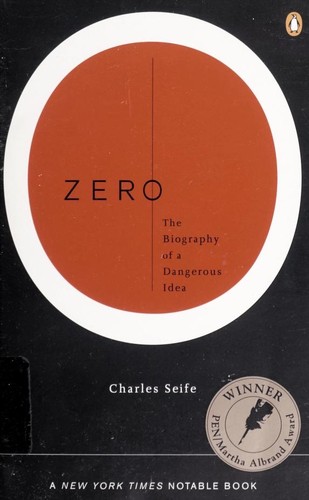
Talk to Zero: The Biography of a Dangerous Idea like its author wrote you back.
Get the ideas that fit your life — not generic summaries.
- Chat with the book
- Audiobook-style main ideas
- Adapts to your life and goals
- Helps you take action
What it argues
The number zero seems self-evidently harmless, but Charles Seife's history argues that zero has been, at various points, theologically threatening, mathematically subversive, and philosophically destabilizing. The book traces zero's biography from its origins in Babylonian and Indian mathematics through its transformation of arithmetic, calculus, and physics, and into quantum mechanics and cosmology, where the infinities and zeros of modern physics continue to raise deep conceptual problems.
The early chapters are cultural history. Ancient Greek mathematics had no zero because the Greeks found the concept incoherent — nothing cannot be a number. The Church in medieval Europe was hostile to zero partly because zero implied a void, and the void was theologically problematic in a cosmos created by God. Indian mathematicians were less constrained by these metaphysical commitments and developed zero as a number with its own arithmetic rules. Arab traders carried the Hindu-Arabic numeral system, including zero, into Europe, where it transformed commerce and science.
What it gets right
- 1.
Zero was not invented independently by every civilization. The Greeks lacked it for philosophical reasons; Indian mathematicians developed it and embedded it in the place-value system that modern arithmetic depends on.
- 2.
Zero and infinity are mathematical inverses — zero times infinity is indeterminate, and the relationship between them generates the paradoxes at the heart of calculus.
- 3.
Calculus works by taking ratios of infinitesimals — quantities approaching zero — and the philosophical discomfort with this foundation drove the development of formal limits in the 19th century.
What it covers
Who wrote it
Charles Seife is an American journalist and professor who teaches science journalism at New York University. He has a master's degree in mathematics from Yale and has written widely on science and technology for Science magazine, Scientific American, and The New Scientist. Zero, published in 2000, was his first book and became a bestseller. He has since written several other popular science books including Proofiness (2010), on the misuse of numbers in public life, and Virtual Unreality (2014), on digital truth and deception.
