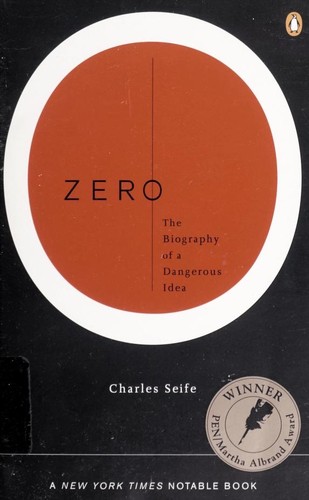
Zero: The Biography of a Dangerous Idea by Charles Seife is a 2000 science book about mathematics, history of ideas, infinity. Zero was not invented independently by every civilization. The Greeks lacked it for philosophical reasons; Indian mathematicians developed it and embedded it in the place-value system that modern arithmetic depends on.
Summary
The number zero seems self-evidently harmless, but Charles Seife's history argues that zero has been, at various points, theologically threatening, mathematically subversive, and philosophically destabilizing. The book traces zero's biography from its origins in Babylonian and Indian mathematics through its transformation of arithmetic, calculus, and physics, and into quantum mechanics and cosmology, where the infinities and zeros of modern physics continue to raise deep conceptual problems.
The early chapters are cultural history. Ancient Greek mathematics had no zero because the Greeks found the concept incoherent — nothing cannot be a number. The Church in medieval Europe was hostile to zero partly because zero implied a void, and the void was theologically problematic in a cosmos created by God. Indian mathematicians were less constrained by these metaphysical commitments and developed zero as a number with its own arithmetic rules. Arab traders carried the Hindu-Arabic numeral system, including zero, into Europe, where it transformed commerce and science.
The mathematical chapters are more substantive. Seife explains how zero and infinity are always paired — you cannot have one without the other — and how this pairing causes problems. Division by zero is undefined; multiplying zero by infinity produces any number you like, or none. These indeterminacies appear at the heart of calculus (the derivative is a ratio of two zeros) and at the heart of physics (quantum field theory and general relativity both generate infinities that have to be managed by mathematical techniques that amount to subtracting one infinity from another). Seife argues that zero and infinity represent the points where mathematics touches genuine mystery.
The book is short and readable and occasionally oversimplifies. Seife is a journalist, not a mathematician, and some of the later physics is handled quickly enough that specialists will wince. But as an introduction to why a number matters — to the history of counting, to the development of calculus, to the structure of modern physics — it's unusually effective. Zero is one of those concepts that seems obvious until you look at it closely, and then stops seeming obvious at all.
Talk to Zero: The Biography of a Dangerous Idea like its author wrote you back.
Get the ideas that fit your life — not generic summaries.
- Chat with the book
- Audiobook-style main ideas
- Adapts to your life and goals
- Helps you take action
Key takeaways
- 1.
Zero was not invented independently by every civilization. The Greeks lacked it for philosophical reasons; Indian mathematicians developed it and embedded it in the place-value system that modern arithmetic depends on.
- 2.
Zero and infinity are mathematical inverses — zero times infinity is indeterminate, and the relationship between them generates the paradoxes at the heart of calculus.
- 3.
Calculus works by taking ratios of infinitesimals — quantities approaching zero — and the philosophical discomfort with this foundation drove the development of formal limits in the 19th century.
- 4.
Division by zero is undefined in standard arithmetic, but the rules for handling near-zero quantities are the basis for everything from derivatives to digital signal processing.
- 5.
In modern physics, both general relativity (at singularities) and quantum field theory (in loop calculations) produce infinities that have to be managed through renormalization — a process that amounts to subtracting one infinity from another.
- 6.
The absolute zero of temperature is the point where molecular motion would theoretically cease completely — a physical concept with deep connections to zero in mathematics and information theory.
- 7.
Zero's acceptance in Europe was resisted partly on theological grounds and partly because the merchants who adopted Hindu-Arabic numerals for practical arithmetic had to fight against established authority.
- 8.
Seife argues that zero and infinity mark the edges of mathematics — the points where standard rules break down and where deeper physical understanding is needed.
Discussion questions
Use these on your own, with a book club, or as chat starters in Superbook. Book club version, ready to copy or print →
- 1.
Why do you think the ancient Greeks resisted the concept of zero? What does that tell us about how philosophical commitments shape mathematics?
- 2.
Seife pairs zero and infinity throughout the book. Before reading, had you thought of them as related? Does the pairing feel natural to you now?
- 3.
The Church's resistance to zero is often cited as an example of religion obstructing science. Is that a fair reading of the history Seife presents?
- 4.
Calculus was developed on philosophically shaky foundations — the infinitesimal — and worked brilliantly before those foundations were made rigorous. What does that suggest about how mathematics actually progresses?
- 5.
Physics generates infinities in its most accurate theories, and manages them through renormalization. How do you feel about a physical theory that requires this kind of mathematical housekeeping?
- 6.
Seife argues that zero represents genuine mathematical mystery, not just complexity. Is there a difference between a problem that's hard and one that's genuinely mysterious?
- 7.
The Hindu-Arabic numeral system — including zero — was a prerequisite for modern commerce and science. What contemporary tools do we use without thinking about the conceptual breakthroughs behind them?
- 8.
What other ideas can you think of that were resisted for cultural or religious reasons before being accepted as obviously correct?
- 9.
The book claims division by zero is not just technically undefined but philosophically significant. Does that argument convince you?
- 10.
How does the history of zero change how you think about mathematical concepts that seem simple and self-evident?
- 11.
Seife ends with quantum gravity and the Big Bang — places where zero and infinity collide in physics. Does that make the book feel complete, or like it runs out of space?
- 12.
The book is sometimes criticized for oversimplifying the physics. How much oversimplification is acceptable in popular science writing?
Themes
Frequently asked questions
-
Is Zero: The Biography of a Dangerous Idea worth reading?
Yes, if you are curious about the history of mathematical concepts and want an accessible entry point. The book is short, readable, and covers a surprising amount of intellectual history. Readers with strong math or physics backgrounds may find some later sections too breezy, but as popular science it is effective.
-
How long does it take to read Zero?
About four to five hours. The book is under 250 pages and reads quickly. It can be finished comfortably in a weekend. The physics chapters toward the end are denser than the history chapters and may require rereading.
-
Is this a math book or a history book?
Both. The early chapters are cultural and intellectual history, tracing zero through Babylon, India, Greece, and medieval Europe. The middle and later chapters are about the mathematics and physics that depend on zero. The balance shifts toward mathematics roughly halfway through.
-
Who should read this book?
Curious general readers interested in the history of ideas, particularly ideas that seem obvious in retrospect but required centuries to develop and accept. It's a good introduction for anyone who wants to understand why seemingly simple mathematical concepts have deep histories.
-
Does the book explain calculus?
It explains the conceptual foundations of calculus — that derivatives and integrals involve limits of quantities approaching zero — without requiring calculation. Readers who want to understand why calculus works philosophically will find the relevant chapters useful. Readers wanting to learn calculus itself will need a different book.